
A commission can be earned without ever becoming cash in your bank account.
The booking may be complete. The traveler may already be home. Your supplier may owe the agency commission — but weeks later, the payment is still missing.
That is where unpaid travel agent commissions become a real cash-flow problem.
The challenge is rarely calculating what you should have earned. The harder part is identifying which commissions were never received, which were only partially paid, which are genuinely overdue, and which simply have not reached their normal payment date yet.
A good commission recovery process should therefore answer four questions:
- What should have been paid?
- What has actually been received?
- What amount is still outstanding?
- Which missing payments deserve attention first?
Current travel-agency commission systems use this same distinction: expected dates are used to distinguish upcoming from overdue commission, while partial payments remain open when additional commission is still expected. Tern’s commission reconciliation guidance illustrates this workflow.
This guide shows you how to build that process.
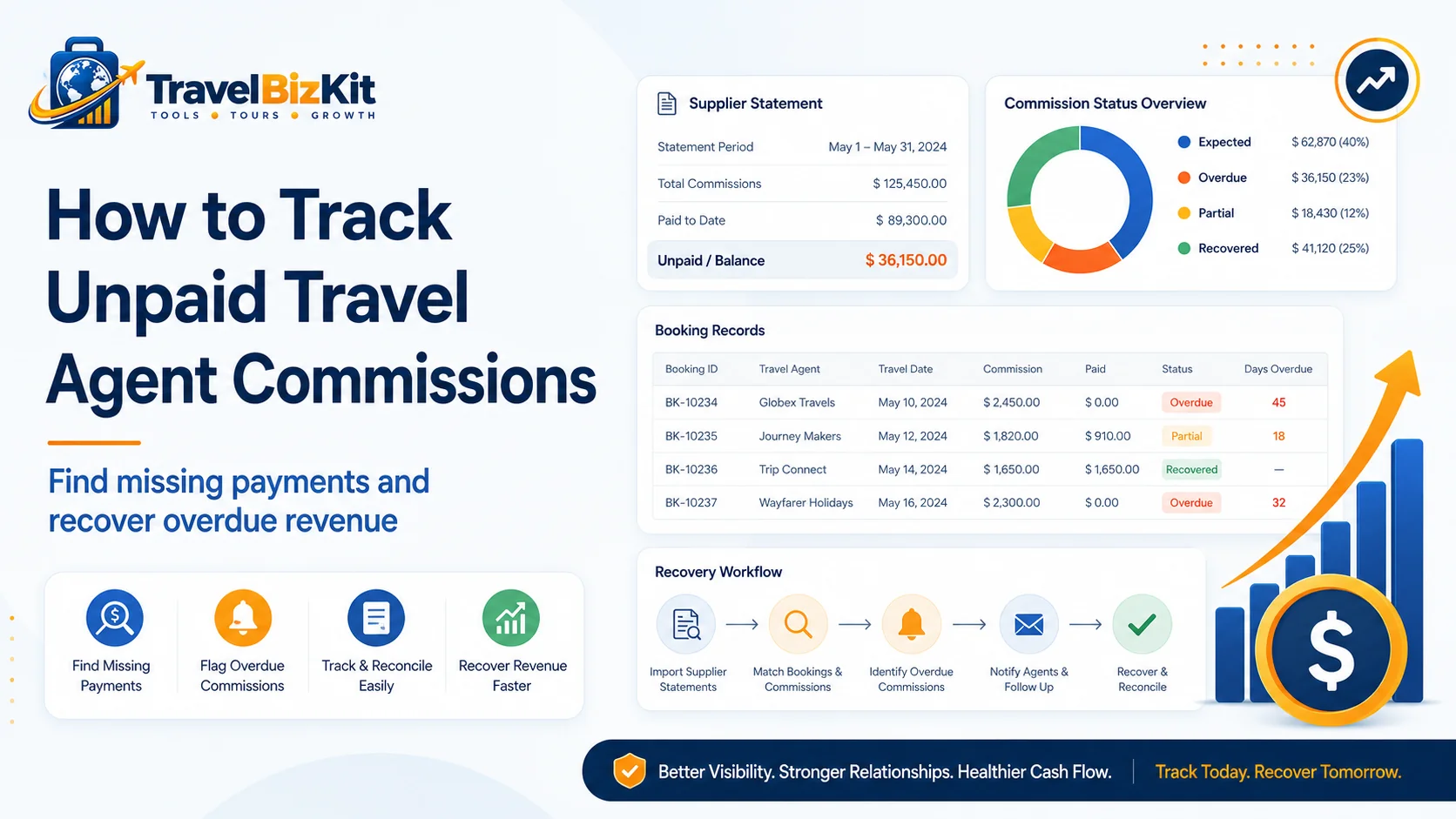
Key Takeaways
- Do not treat expected commission as received revenue.
- A commission should not become Overdue until the expected payment date has passed.
- Track the outstanding balance, not only whether a payment exists.
- A partial payment should remain open while additional commission is expected.
- Match supplier payments back to the relevant bookings before closing them.
- Keep an overdue queue organized by supplier, amount, age and follow-up status.
- Prioritize high-value and older items rather than chasing every commission equally.
- Preserve a follow-up history so the same missing payment is not forgotten or repeatedly investigated from scratch.
- Close a commission only when the expected amount has been explained, received, adjusted or otherwise resolved.
What Is an Unpaid Travel Agent Commission?
An unpaid travel agent commission is commission you expected to receive from a supplier or host agency but have not received according to the payment terms or expected payment schedule applicable to that booking.
The word expected is important.
A booking being completed yesterday does not automatically mean its commission is overdue today.
Different suppliers and booking types can follow different payment schedules. Some commission may not be payable until after travel, while other arrangements can involve longer settlement cycles.
So a useful system does not simply ask: “Has this booking paid yet?”
It asks: “Has this booking passed the date when we reasonably expected the commission to arrive?”
That expected payment date is what allows you to distinguish between upcoming commission and overdue commission. Without it, every unpaid booking looks the same.
Why Travel Agencies Lose Track of Earned Commission
The underlying problem is timing.
A booking can be created today while the commission is not received until weeks or months later.
During that gap:
- new bookings arrive,
- clients travel,
- reservations change,
- suppliers issue different statements,
- advisors move on to new sales,
- and yesterday’s expected commission can quietly fall off the radar.
Commission-tracking providers describe exactly this problem: agencies need visibility into what was expected, what was received and what is still owed because payment timing can lag far behind the original booking. Destinito Pro’s commission-tracking overview discusses this gap.
Specialized recovery providers also report that unpaid commission can result from issues such as incorrect booking identifiers, reporting discrepancies or records that were never reconciled correctly. Commtrak focuses on recovering past-due travel commissions.
The important lesson is: Commission recovery starts before the commission becomes old.
You need a system that tells you when something is starting to go wrong.
5 Warning Signs a Commission Still Needs Attention
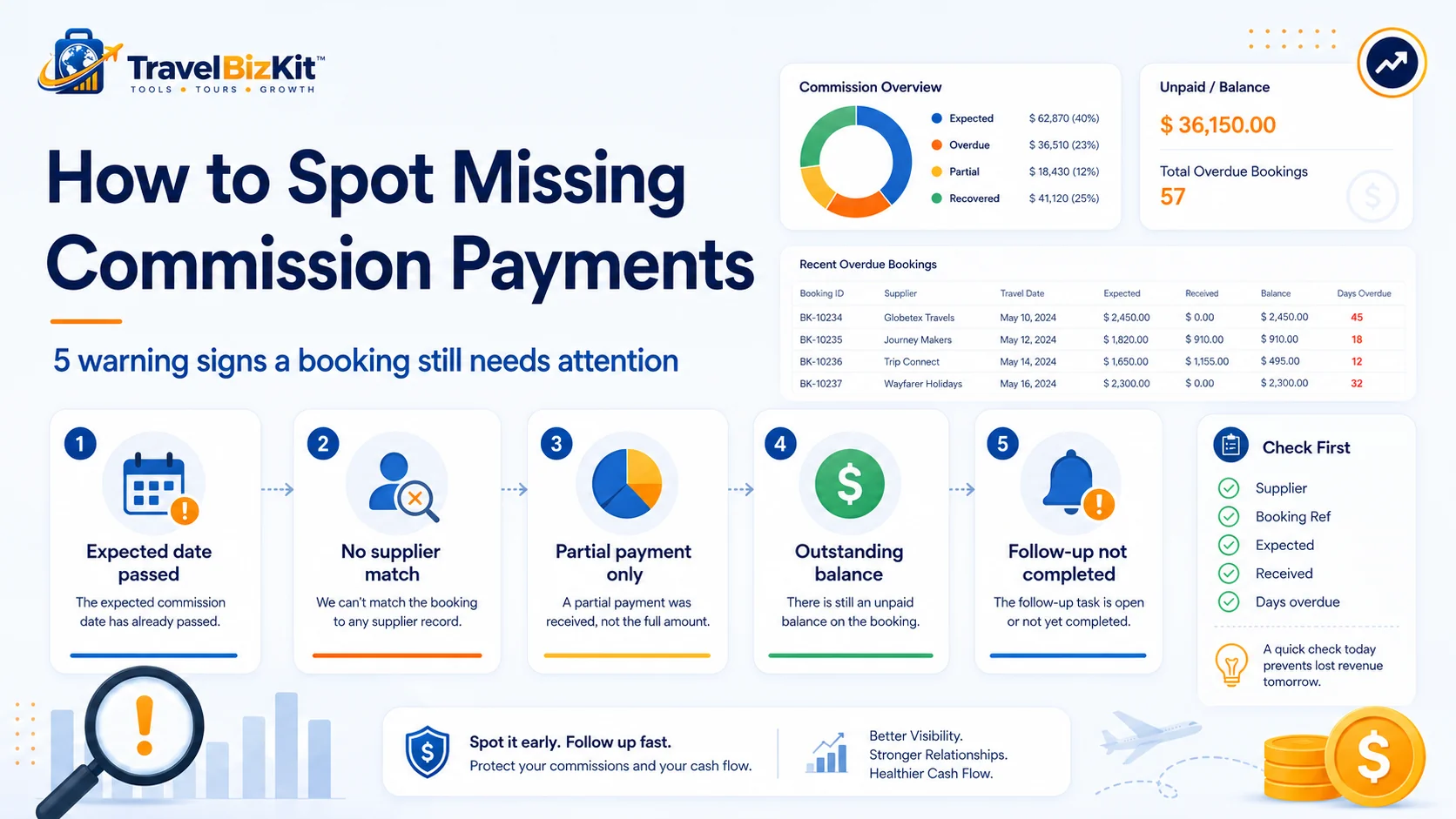
There are five signals that should immediately put a commission into your review workflow.
1. The Expected Payment Date Has Passed
This is the clearest signal.
If Expected Payment Date < Today and Outstanding Commission > $0, the booking needs review.
That does not necessarily mean the supplier has made a mistake. But it does mean the payment is now outside the timeframe you expected and should no longer remain invisible among normal pending bookings.
2. You Cannot Match the Supplier Payment to the Booking
Sometimes money arrives but you cannot tell which booking it belongs to. That is not the same problem as no payment arriving, but it still leaves your commission records unresolved.
For example, suppose a supplier deposit is $865 and a possible booking has expected commission of $900. You should not automatically force the $865 into that booking simply because the amounts look similar.
Instead, verify:
- confirmation number,
- supplier,
- client,
- travel dates,
- statement reference,
- advisor,
- payment amount.
Until the payment can be confidently matched, keep it visible as unmatched or unclaimed. For the full workflow, see our guide to travel agent commission reconciliation.
3. Only Part of the Commission Was Paid
Partial payments are one of the easiest ways to lose revenue in a basic spreadsheet.
Imagine an expected commission of $780 and a payment received of $420. A poorly structured tracker may show Paid = Yes.
A better tracker shows:
- Expected: $780
- Received: $420
- Outstanding: $360
- Status: Partial
If additional commission is still expected, the booking remains open. Current travel-agency commission workflows explicitly support logging multiple payments against the same booking rather than closing it after the first receipt.
4. There Is Still an Outstanding Balance
This sounds obvious, but it is more useful than relying on labels alone.
Use the calculation:
Expected Commission − Total Commission Received = Outstanding Commission
If the outstanding amount is greater than zero, you still have something to explain. Maybe the remaining balance is not due yet, partially paid, overdue, adjusted, disputed or no longer collectible. But until you know which one, the booking should not silently disappear.
5. The Follow-Up Is Still Open
Finding an unpaid commission is not the same as recovering it.
Your tracker should also tell you whether somebody has actually followed up. Useful fields include:
- Last follow-up date
- Follow-up owner
- Supplier contacted
- Response received
- Next action
- Next follow-up date
- Dispute/reference number
- Notes
Otherwise the agency may identify the same missing payment repeatedly without ever moving it toward resolution.
How to Know Whether a Commission Is Actually Overdue
One of the biggest mistakes is setting the same arbitrary payment deadline for every supplier.
Instead, your expected commission date should come from the best information you have available, such as supplier terms, host-agency policy, supplier statement cycle, historic payment behavior, contract terms and verified payment guidance.
Then your system can apply a simple rule:
- Upcoming: Expected date is still in the future.
- Overdue: Expected date has passed and no expected commission has been fully received.
- Partial: Some commission has been received, but additional commission is still expected.
- Received: The expected commission has been fully accounted for and no additional payment is expected.
That type of status model is used in current travel commission systems precisely because “paid or unpaid” is too simplistic.
What to Track Before a Commission Can Be Recovered
A recovery process is only as good as the booking data behind it. For every commissionable booking, try to maintain:
| Field | Purpose |
|---|---|
| Booking ID | Internal reference |
| Supplier | Who owes the commission |
| Confirmation number | Supplier-side matching |
| Client / trip | Identifies the reservation |
| Travel date | Provides payment context |
| Commissionable amount | Base used for commission |
| Commission rate | Expected percentage |
| Expected commission | What should be paid |
| Expected payment date | Determines overdue status |
| Total received | Actual payment recorded |
| Outstanding balance | Remaining gap |
| Status | Upcoming / Partial / Overdue / Received |
| Days overdue | Measures age |
| Last follow-up | Prevents forgotten recovery |
| Next action | Keeps recovery moving |
| Notes / dispute reference | Preserves history |
The most useful recovery fields are often not the original booking fields. They are Outstanding Amount + Days Overdue + Follow-Up Status because those tell you what to work on next.
A Practical Commission Recovery Workflow
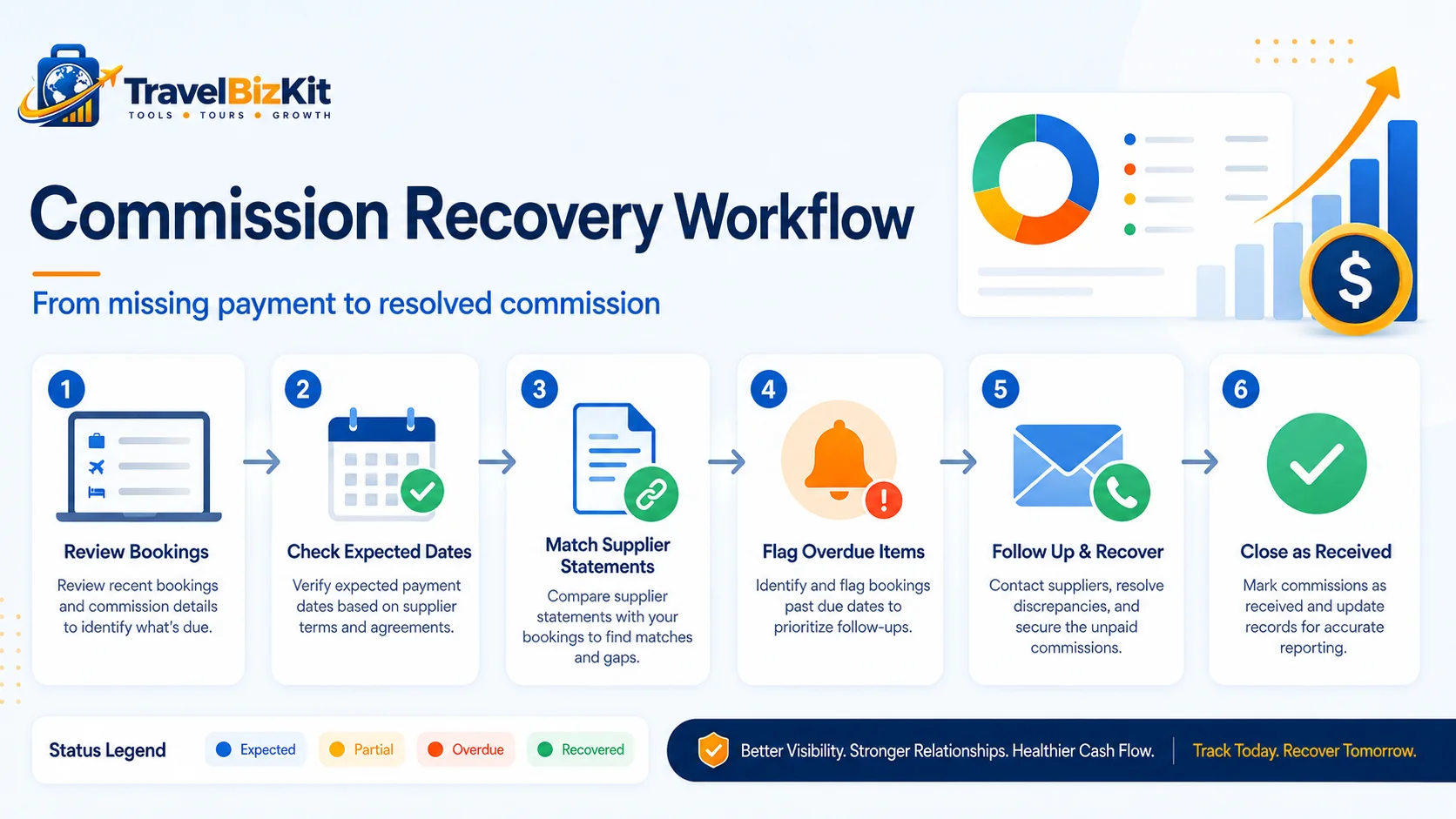
You can build a reliable workflow in six stages.
Step 1: Review Commissionable Bookings
Start with bookings that should generate commission. Confirm the supplier, booking reference, expected commission, travel completion and payment expectation. Do not wait until something is overdue before making sure the expected commission exists in your records.
Step 2: Check Expected Payment Dates
Review the bookings whose expected commission dates are approaching or have already passed. Create clear buckets:
- Upcoming
- Overdue 1–30 days
- Overdue 31–60 days
- Overdue 61–90 days
- Overdue 90+ days
The exact aging ranges can be adapted to your business. The objective is to prevent a 90-day-old missing commission from looking identical to something that became overdue yesterday.
Step 3: Match Supplier Statements and Payments
Before assuming the supplier did not pay, check supplier statements, host statements, ACH/remittance records, booking references and confirmation numbers.
The commission may have arrived but not been matched correctly. A recovery workflow should therefore connect closely to reconciliation. See Travel Agent Commission Reconciliation: How to Match Supplier Payments to Bookings for the complete process.
Step 4: Flag True Overdue Items
Once you verify that the commission was expected, the expected date passed, and the payment is still missing or incomplete, move the item into the recovery queue. Do not keep it mixed with normal upcoming commission. This creates a focused list of bookings that actually need action.
Step 5: Follow Up and Recover
Contact the appropriate supplier or host team with enough information to make the request easy to investigate. A useful follow-up should normally include relevant information such as:
- booking reference,
- supplier confirmation,
- traveler name where appropriate,
- travel dates,
- expected commission,
- amount received,
- outstanding amount,
- relevant statement/reference.
Avoid sending a vague message like: “You still owe us commission.” A structured request gives the supplier a much better starting point.
Step 6: Close the Commission Correctly
Do not close the recovery item simply because a supplier responded. Close it when the financial outcome has been explained.
- Recovered — outstanding commission received.
- Adjusted — expected amount changed for a verified reason.
- Clawback / correction — previous commission required adjustment.
- Not collectible / closed — agency has documented why it will no longer pursue it.
The key is that the record should explain why the balance became zero or why the case was closed.
Build a Commission Recovery Queue
A recovery queue is more useful than one long list of unpaid bookings. It should help answer: What should I chase first?
Consider these dimensions:
- Amount Outstanding: $1,500 generally deserves more immediate attention than $25.
- Days Overdue: A large payment that became overdue yesterday may be less urgent than a similar payment unresolved for 70 days.
- Status: A booking with zero commission received is different from one that is 95% paid.
- Supplier: If one supplier has ten overdue commissions, you may be able to resolve several in one structured follow-up.
- Follow-Up Activity: An untouched commission may need action before one where the supplier already promised payment next week.
A Simple Priority Model
You do not need a complicated AI score. A basic recovery model could use:
- Critical: High outstanding value + significantly overdue + no resolution.
- High: Meaningful outstanding value or older overdue item.
- Medium: Moderate amount with recent follow-up needed.
- Low: Small amount, newly overdue or already being resolved.
The purpose is not to create a perfect score. The purpose is to prevent your team from spending 30 minutes chasing $20 while a $900 commission has been missing for two months.
Worked Example: Recovering Unpaid Commission
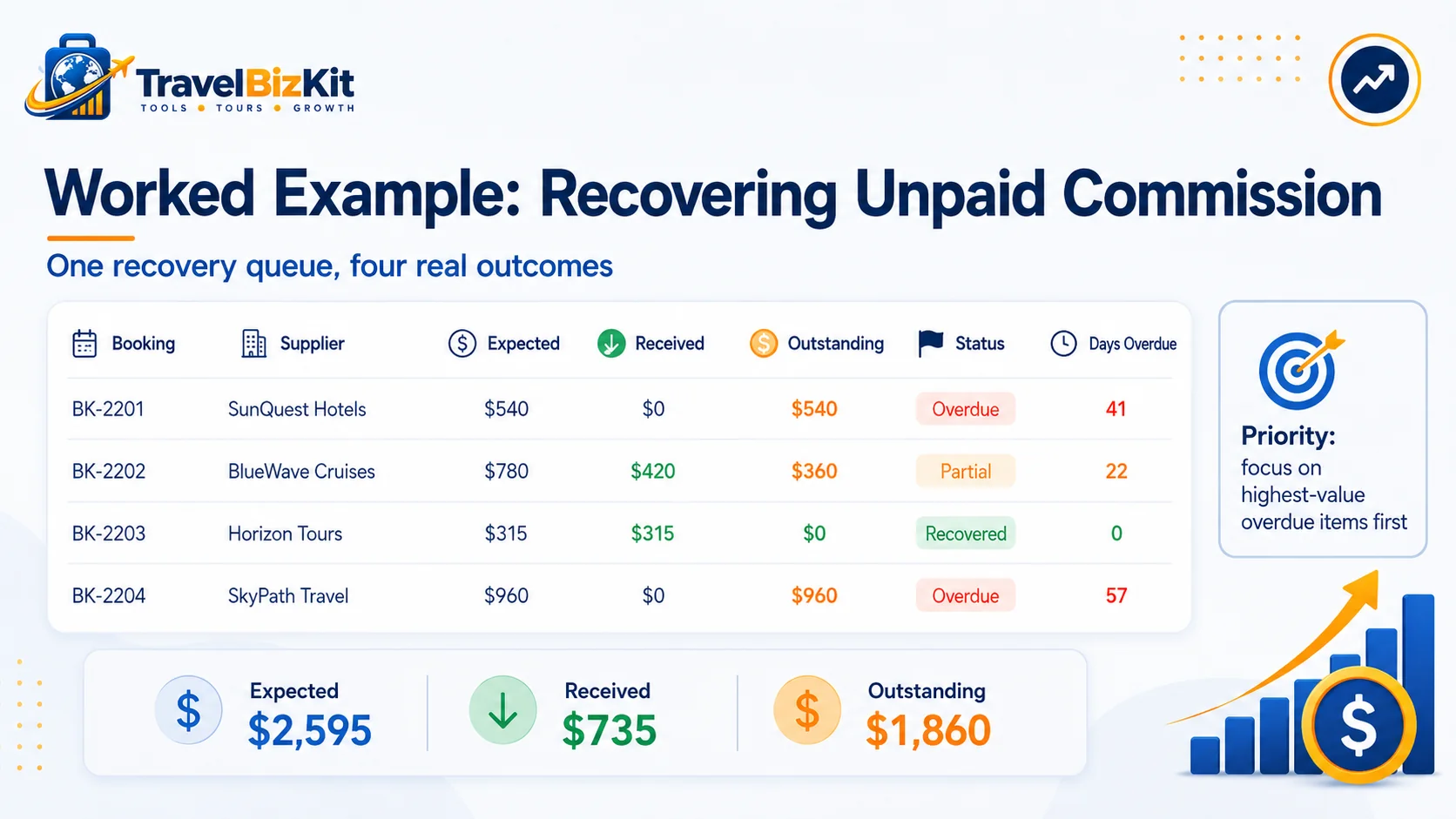
Imagine this fictional recovery queue:
| Booking | Supplier | Expected | Received | Outstanding | Status | Days Overdue |
|---|---|---|---|---|---|---|
| BK-2201 | SunQuest Hotels | $540 | $0 | $540 | Overdue | 41 |
| BK-2202 | BlueWave Cruises | $780 | $420 | $360 | Partial | 22 |
| BK-2203 | Horizon Tours | $315 | $315 | $0 | Recovered | 0 |
| BK-2204 | SkyPath Travel | $960 | $0 | $960 | Overdue | 57 |
These supplier names are illustrative.
Total Expected: $540 + $780 + $315 + $960 = $2,595
Total Received: $0 + $420 + $315 + $0 = $735
Total Outstanding: $540 + $360 + $0 + $960 = $1,860
BK-2203 — Horizon Tours
Expected: $315. Received: $315. Outstanding: $0. Action: Close as Recovered. No further recovery work is needed.
BK-2202 — BlueWave Cruises
Expected: $780. Received: $420. Outstanding: $360. Days overdue: 22. Action: Confirm whether the $360 is still expected. If it is, keep the status Partial and follow up on the remaining balance.
BK-2201 — SunQuest Hotels
Expected: $540. Received: $0. Days overdue: 41. Action: High-priority follow-up. Verify that no unmatched supplier payment exists first. Then contact the supplier using the booking and commission details.
BK-2204 — SkyPath Travel
Expected: $960. Received: $0. Days overdue: 57. This has the highest outstanding amount, the oldest overdue age among active cases and no payment recorded. Action: Highest recovery priority.
That is what a recovery queue does. It turns “We are missing $1,860” into “Start with BK-2204, then BK-2201, then resolve the remaining balance on BK-2202.” That is much more actionable.
Do Not Chase Commission Before Checking for an Unmatched Payment
Before contacting a supplier, check whether the money has actually arrived somewhere else in your records.
For example, a booking expected $960 and your booking record says Received = $0, but your latest supplier statement includes an unclaimed payment of $935. Those two numbers are close enough to investigate — but not close enough to assume.
First match the supplier, confirmation number, traveler, dates and reference. If the $935 is confirmed to belong to the $960 booking, the outstanding amount is $25, not $960.
That is why reconciliation should happen before aggressive recovery activity.
How to Follow Up With a Supplier About Missing Commission
A useful commission follow-up should be short, factual and easy to investigate.
Subject: Commission Payment Follow-Up — Booking ABC123
Hello,
We are reconciling commission for booking ABC123, travel completed on [date].
Our records show expected commission of $540, but we have not yet identified the corresponding payment.
Could you please confirm the payment status and any related remittance reference?
Thank you.
You may also include agency details, IATA/CLIA/agency identifier where applicable, confirmation number, invoice/reference and relevant documentation.
Do not send sensitive traveler information that is not necessary for the investigation.
Keep a Follow-Up History
Your recovery tracker should record each contact attempt.
| Date | Action | Result | Next Step |
|---|---|---|---|
| Jul 3 | Email supplier | No reply | Follow up Jul 10 |
| Jul 10 | Second email | Supplier requested confirmation | Send document |
| Jul 11 | Confirmation sent | Under review | Check Jul 18 |
| Jul 17 | Supplier confirmed payment | Payment pending | Verify receipt |
Now somebody else in the agency can understand the case immediately. Without this history, recovery work becomes dependent on one person’s inbox and memory.
Group Overdue Commission by Supplier
Do not only view overdue commission booking-by-booking. Also review it by supplier.
| Supplier | Overdue Bookings | Outstanding |
|---|---|---|
| Supplier A | 7 | $3,480 |
| Supplier B | 2 | $420 |
| Supplier C | 6 | $2,915 |
| Supplier D | 1 | $85 |
That tells you something the individual booking list cannot: Supplier A may represent a systematic collection issue. Instead of sending seven unrelated emails, your agency may be able to send one structured reconciliation request containing all seven booking references.
Modern commission-management products similarly provide supplier-level views of expected, received and outstanding commission because supplier patterns are operationally valuable. Travel Agent Companion’s commissions reporting overview is one example.
Measure Supplier Commission Performance
Over time, recovery data can help you answer:
- Which suppliers pay reliably?
- Which frequently pay late?
- Which generate the most partial payments?
- Which create the most unmatched commission?
- Which require repeated follow-ups?
- Which represent the largest overdue exposure?
Useful supplier KPIs include:
- Expected Commission: How much commission the supplier should generate.
- Cash Received: How much commission actually arrived.
- Outstanding Commission: What remains unexplained or unpaid.
- Collection Rate: Commission Received ÷ Expected Commission × 100.
- Overdue Exposure: How much unpaid commission is past the expected date.
- Average Days to Payment: How long commission typically takes to arrive.
The point is not necessarily to stop selling a supplier because one payment was late. The point is to understand the cash-flow behavior of the relationships your business depends on.
When Should You Write Off an Unpaid Commission?
There is no universal number of days after which every travel commission should automatically be written off.
The answer depends on supplier rules, contract terms, recovery deadlines, documentation, economics, legal/accounting policy, amount owed and likelihood of recovery.
Specialized hotel-commission recovery companies exist specifically because some aged unpaid commissions can still be pursued rather than automatically considered lost. But that does not mean every old commission is recoverable.
Your agency should define a documented policy for Active recovery → escalation → final review → closure/write-off, with appropriate accounting advice where needed.
The worst policy is: “We eventually forget about it.”
Refunds, Cancellations and Clawbacks Are Different From Unpaid Commission
Do not classify every reduction in commission as missing revenue.
Suppose you expected $600, but a traveler canceled and the supplier legitimately reduced commission to $0. That is not necessarily unpaid commission. It may be a valid adjustment.
Similarly, a previously paid commission might later be reversed because of cancellation, refund, booking modification, overpayment or supplier correction.
Your recovery system should therefore preserve the original expected value and record the adjustment or clawback separately. Otherwise the history gets rewritten and it becomes impossible to understand what actually happened.
Commission Recovery vs Commission Reconciliation
The two workflows are connected but different.
Reconciliation asks: Where did this payment come from?
Recovery asks: Where is the payment that should have come?
A good commission process needs both. You can learn the reconciliation side in Travel Agent Commission Reconciliation: How to Match Supplier Payments to Bookings and the broader tracking foundation in how to track travel agent commissions.
Together the workflow becomes: Track → Reconcile → Identify Gaps → Recover → Close.
A Weekly Commission Recovery Routine
For a small agency, you do not need to review every booking every day. Create a recurring routine.
- Review New Overdue Items: Filter bookings that crossed their expected payment date since your last review.
- Review Partial Payments: Check bookings where a payment arrived but an outstanding balance remains.
- Match New Supplier Statements: Resolve incoming payments before assuming bookings are unpaid.
- Sort the Recovery Queue: Prioritize by outstanding amount, days overdue, supplier and follow-up status.
- Send Follow-Ups: Batch supplier requests where possible.
- Update Follow-Up History: Record what happened.
- Close Resolved Items: Remove recovered or properly adjusted cases from the active queue.
That keeps the recovery list small enough to remain useful.
A Monthly Commission Recovery Report
At month end, summarize:
- Expected Commission: How much the agency expected to earn.
- Commission Cash Received: How much actually arrived.
- New Overdue Commission: What crossed into overdue status this month.
- Total Outstanding Commission: The total unresolved gap.
- Commission Recovered: How much previously overdue commission was successfully collected.
- Partial Payments Outstanding: How much remains on partially paid bookings.
- Oldest Open Item: A useful signal that cases may be aging without resolution.
- Highest-Risk Suppliers: Suppliers with meaningful overdue balances or repeated issues.
This gives management a much stronger view of commission cash flow than simply looking at total sales.
When a Basic Spreadsheet Stops Being Enough
A simple spreadsheet can work when booking volume is low, one person manages commission, few suppliers are involved, payments are simple and reconciliation is straightforward.
But you are probably outgrowing it if you regularly:
- search email to remember whether a commission was chased,
- cannot tell which payments are partial,
- manually calculate outstanding amounts,
- lose follow-up notes,
- struggle to match statement payments,
- pay advisors before confirming supplier receipts,
- or discover old commissions months after they became overdue.
At that point, the real problem is no longer “Where do I put the commission amount?” It is “How do I manage the entire commission lifecycle?” Explore more purpose-built Business Tools for travel workflows.
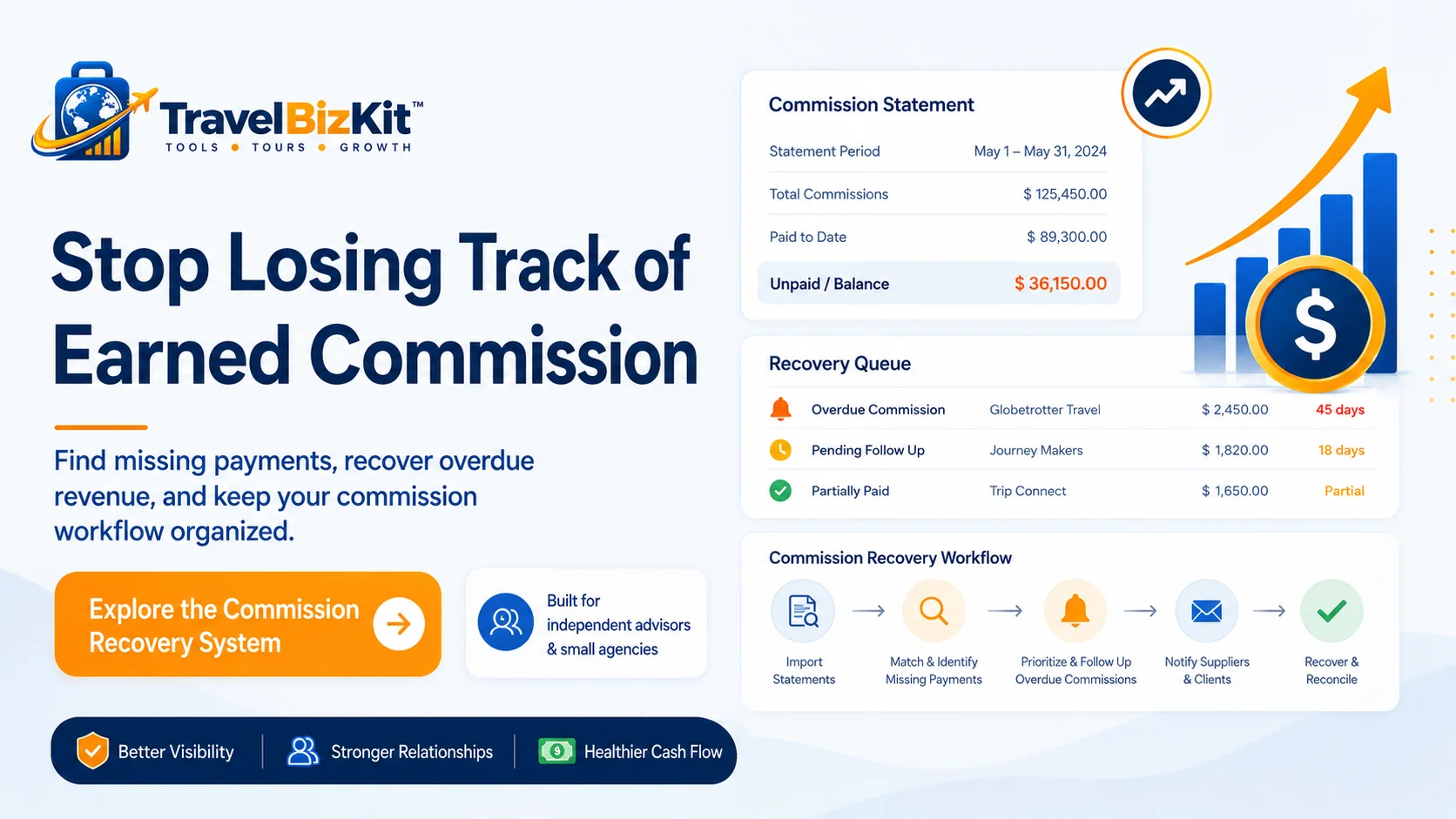
Stop Losing Track of Earned Commission
If unpaid travel agent commissions are being managed through scattered spreadsheets, emails and memory, a more structured system can make the recovery process easier to control.
The TravelBizKit Commission Recovery System brings together:
- expected vs received commission,
- partial payments,
- overdue commission,
- multiple receipt records,
- statement matching,
- unmatched receipts,
- recovery priorities,
- supplier performance,
- host and advisor splits,
- adjustments and clawbacks,
- follow-up visibility,
- data-quality checks,
- Formula Integrity checks,
- management reporting,
- and a 60-scenario QA layer.
It is designed for independent travel advisors and small agencies that need more control than a basic commission spreadsheet without immediately moving into another monthly SaaS platform.
Frequently Asked Questions
How do I track unpaid travel agent commissions?
Track the expected commission, expected payment date, actual commission received and outstanding balance for each booking. Once the expected date passes with money still outstanding, move the booking into an overdue or recovery workflow.
When is a travel agent commission considered overdue?
A commission should generally be considered overdue when its expected payment date has passed and the full amount you still reasonably expect has not been received. The expected date should be based on the supplier or host payment terms relevant to the booking rather than an arbitrary universal deadline.
How do I recover a missing travel commission?
First verify that the commission is actually due and has not already arrived as an unmatched payment. Then gather the booking reference, supplier confirmation, travel dates, expected commission, received amount and relevant documentation before contacting the supplier or host for payment status.
What is the difference between partial and overdue commission?
Partial means at least some commission has been received while additional payment is still expected. Overdue means the expected payment date has passed and commission remains outstanding. A commission can effectively be both partial and overdue from a recovery-management perspective.
What should I include in a commission recovery tracker?
Include supplier, booking ID, confirmation number, expected commission, expected payment date, received amount, outstanding amount, status, days overdue, follow-up history, next action and any dispute or statement references.
Should I chase every overdue commission immediately?
Not necessarily with the same priority. Verify payment status first, then prioritize based on amount outstanding, age, supplier patterns and existing follow-up activity.
Can supplier statements help find missing commission?
Yes. Reconcile supplier statements with your booking records before assuming no payment was made. Some apparent unpaid commissions may actually be payments that have not yet been matched to the correct booking.
Can a travel agent commission be recovered months later?
Sometimes, but it depends on the supplier, documentation, contractual rules, deadlines and circumstances. Do not assume every old commission is recoverable or automatically lost. Review the applicable supplier rules and your agency’s recovery policy.
Is Excel enough to track unpaid commissions?
It can be for an independent advisor or small agency if the workbook supports expected versus received commission, partial receipts, outstanding balances, due dates, recovery priorities and follow-up records. Higher-volume agencies may eventually benefit from dedicated back-office software.
What is a commission recovery queue?
A commission recovery queue is a prioritized list of unresolved commission items showing factors such as outstanding amount, days overdue, status, supplier and next action. Its purpose is to tell you what deserves attention first rather than simply listing every unpaid booking.