
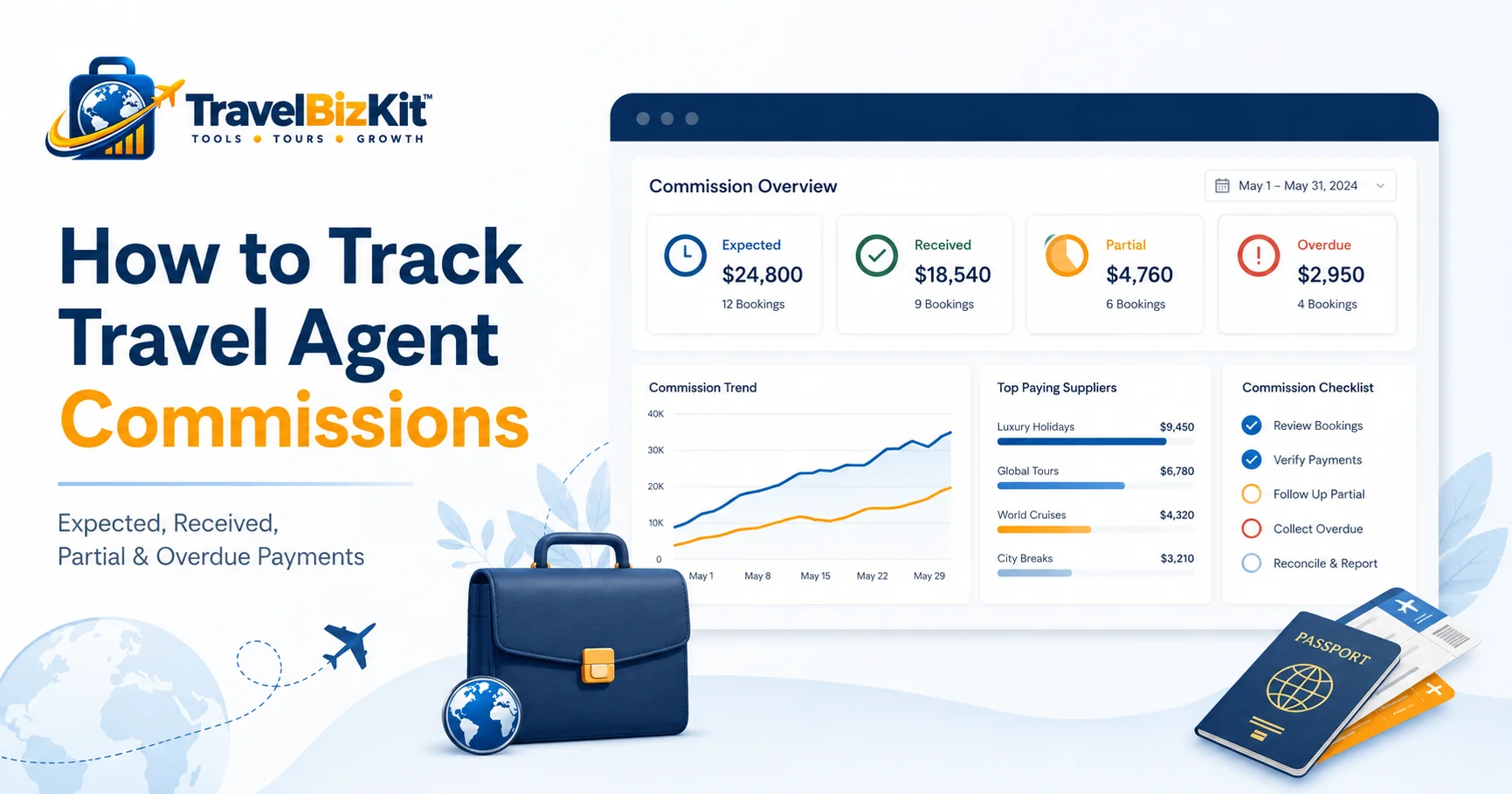
A travel booking can be fully paid, completed, and closed from the client’s point of view while the commission attached to that booking is still somewhere in the payment process.
That gap is where commission tracking gets difficult.
Knowing that a booking should generate a 10% or 12% commission is only the beginning. A useful travel agent commission tracker also needs to tell you how much you expected to earn, when you expected to receive it, how much actually arrived, whether the payment was complete, and what still needs to be followed up.
For an independent advisor or small travel agency, that difference matters. A commission that exists in a booking record is not the same thing as cash that has actually been received.
This guide explains how to track travel agent commissions from the moment a booking is created until the commission is fully reconciled.
Key Takeaways
- Track expected commission and actual cash received separately.
- Give every commission a clear status: Expected, Received, Partial, or Overdue.
- Store the supplier, booking reference, commissionable amount, rate, expected payment date, received amount, and outstanding balance.
- Never mark a booking “paid” simply because one payment arrived if additional commission is still due.
- Reconcile supplier statements against individual bookings instead of relying only on bank deposits.
- Review outstanding commission regularly so missing revenue does not disappear inside old bookings.
- When booking volume grows, move beyond a basic spreadsheet toward a structured recovery and reconciliation workflow.
How to Track Travel Agent Commissions: What It Actually Means
At its simplest, commission tracking answers two different questions:
What should the business earn?
and
What has the business actually received?
Those numbers are often different.
Suppose a supplier booking should generate $600 in commission. Recording $600 commission in a booking spreadsheet tells you the expected value, but it does not tell you whether the supplier has paid it.
If the supplier later sends $350, you now have three important numbers:
| Metric | Amount |
|---|---|
| Expected commission | $600 |
| Commission received | $350 |
| Commission outstanding | $250 |
A system that only stores the original $600 cannot tell you whether that revenue is still expected, partially received, completely received, or overdue.
That is why professional commission tracking should follow the lifecycle of the payment, not just calculate a percentage.
The 4 Commission Statuses You Need to Track
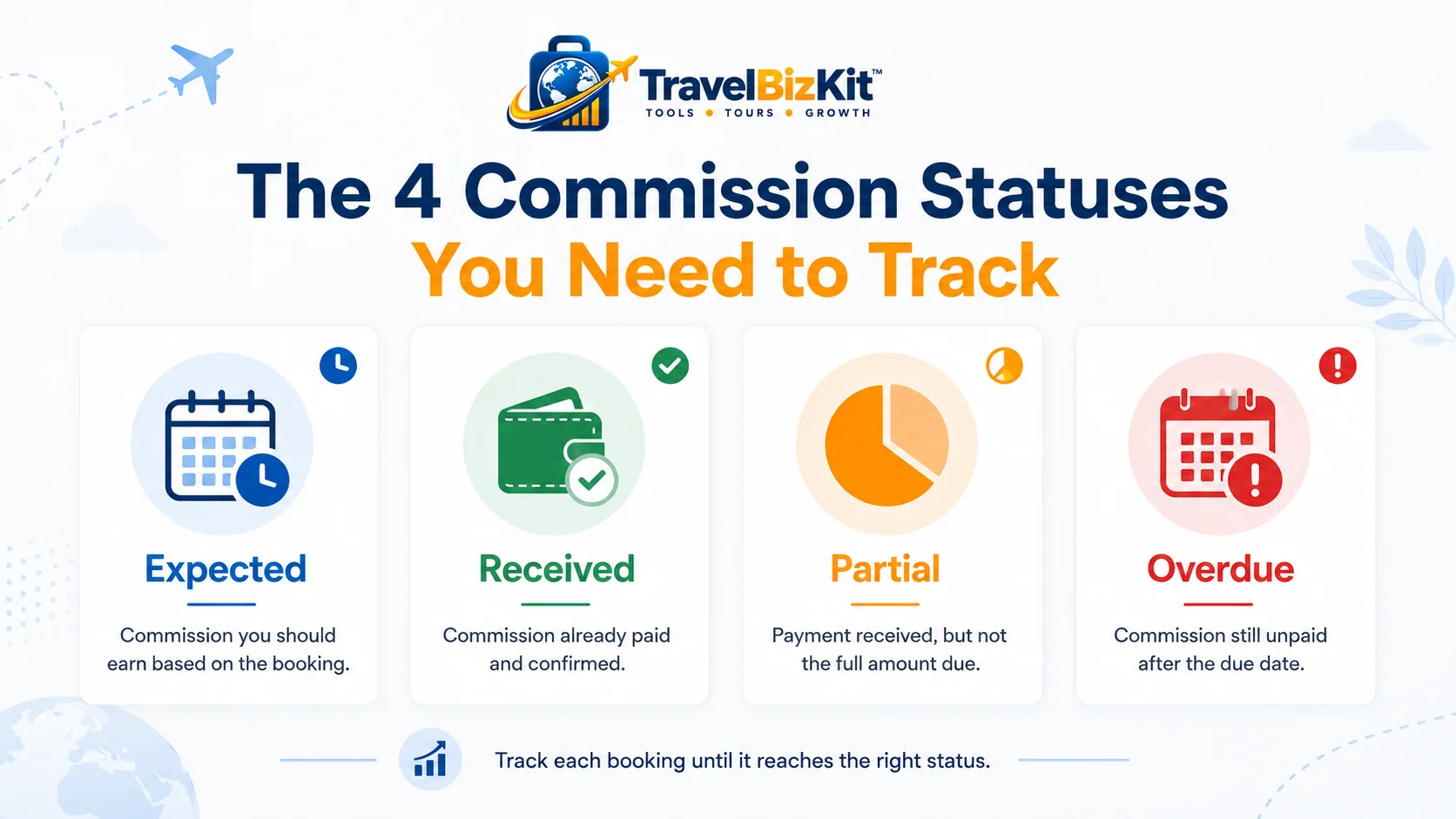
A practical travel agency commission tracking workflow can be built around four core statuses.
Expected
Expected commission is money you reasonably anticipate receiving based on a confirmed commissionable booking.
For example, if the commissionable amount is $4,000 and the supplier commission rate is 10%, the expected gross commission is:
$4,000 × 10% = $400
The important word here is expected.
That $400 should not automatically be treated as received cash.
Your tracker should keep the expected amount visible until you can match it to an actual supplier payment.
Received
A commission becomes Received when the relevant payment has actually been recorded and you are not expecting an additional payment for that commission line.
The tracker should ideally record more than the amount. It should also capture the date received and the booking or supplier statement associated with the payment.
That gives you an audit trail later instead of forcing you to remember why a booking was marked paid.
Partial
Partial commission is one of the most important statuses because it is easy to miss in a basic spreadsheet.
Imagine you expect $700 from a supplier but receive $450.
- Expected: $700
- Received: $450
- Outstanding: $250
- Status: Partial
The booking stays visible until the remaining payment is resolved.
Current travel-agency commission systems use this same distinction: when additional supplier payments are expected, the booking remains partially received rather than being treated as fully reconciled.
Overdue
A commission becomes Overdue when its expected payment date has passed and the expected amount has not been fully received.
Overdue does not automatically mean the supplier has refused to pay.
It means the commission deserves attention.
That distinction helps your business focus on exceptions instead of repeatedly reviewing every booking in the system.
What Should You Track for Every Commissionable Booking?
The quality of your commission reporting depends heavily on the information captured when the booking is created.
A useful tracking record should be able to answer these questions:
| Field | Why It Matters |
|---|---|
| Booking ID / confirmation | Gives each transaction a reliable reference |
| Client / trip reference | Helps identify the booking internally |
| Supplier | Shows who is responsible for the commission |
| Travel or completion date | Helps determine when commission may become payable |
| Booking value | Provides commercial context |
| Commissionable amount | Prevents calculating commission on non-commissionable charges |
| Commission rate | Calculates expected gross commission |
| Expected commission | Shows what should eventually be received |
| Host / advisor split | Shows who ultimately keeps the commission |
| Expected payment date | Allows overdue detection |
| Amount received | Records actual cash collected |
| Outstanding amount | Shows the remaining gap |
| Payment date | Creates a useful reconciliation trail |
| Commission status | Expected, Received, Partial or Overdue |
| Last follow-up | Helps prevent duplicate or forgotten supplier contact |
Not every agency needs the exact same fields, but one rule is universal:
Do not mix an estimate of future commission with confirmed commission cash.
Keeping those two values separate makes almost every other report more useful.
A Simple Workflow for Tracking Travel Agent Commissions
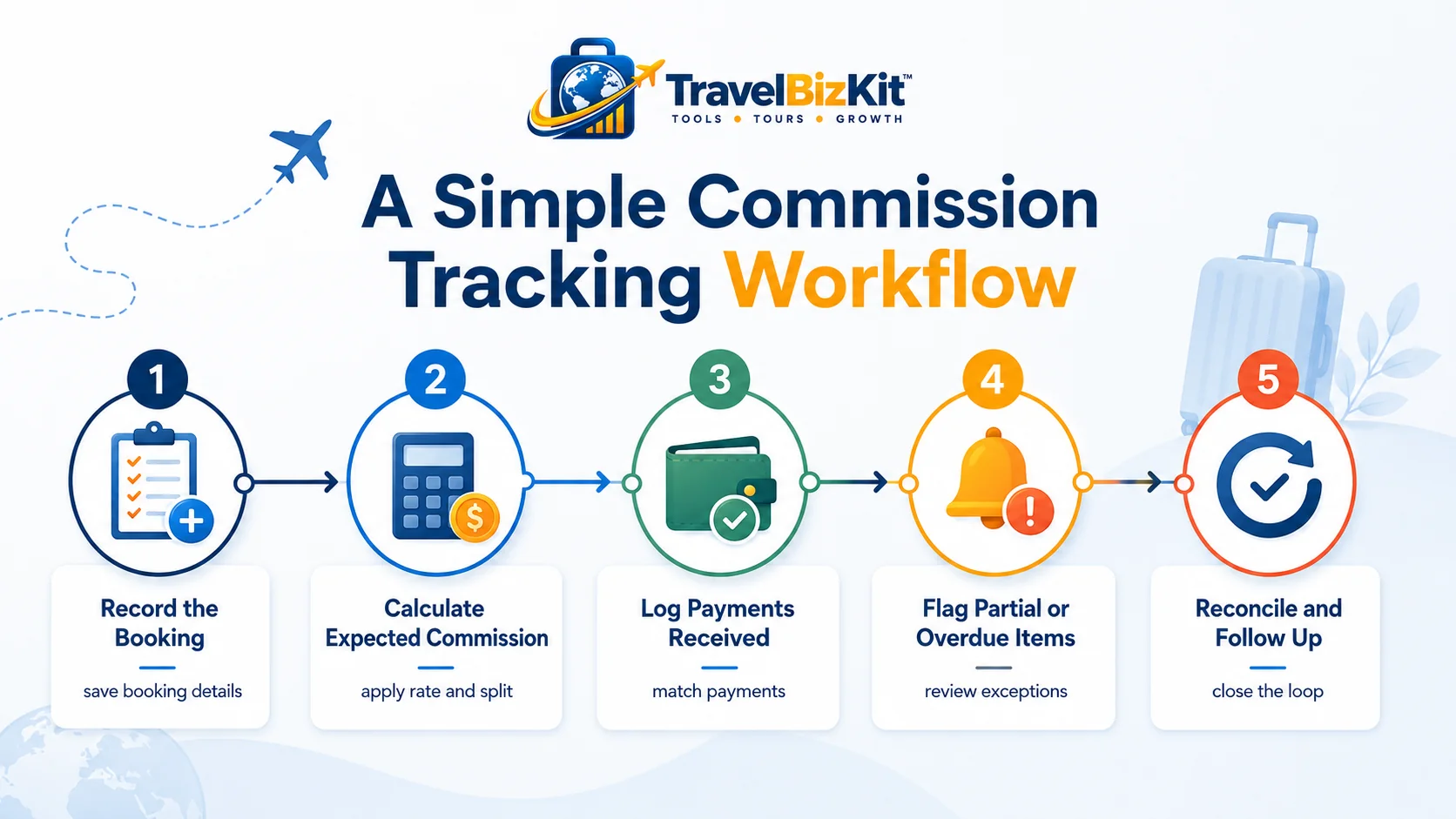
The process does not need to be complicated. What matters is that every commission follows the same workflow.
Step 1: Record the Booking
Create the booking record as soon as the sale is confirmed.
Capture the supplier, booking reference, travel dates and the commercial details needed to calculate commission.
If one booking contains several suppliers or different commission rules, consider creating separate revenue lines rather than forcing everything into one total.
A package might contain a hotel, cruise, transfer, insurance product and service fee. Those components do not necessarily have the same commission economics.
Step 2: Calculate Expected Commission
Identify the portion of the booking that is actually commissionable.
Then apply the supplier commission rate.
The basic calculation is:
Commissionable Amount × Commission Rate = Expected Gross Commission
If a host agency or advisor split applies, calculate that separately.
This gives you visibility into gross supplier commission and what your own business expects to retain.
Step 3: Set an Expected Payment Date
Do not use a universal payment assumption for every supplier.
Instead, base the expected date on your supplier agreement, host-agency rules, historical payment pattern, or other information you can reasonably verify.
The purpose is not to predict the exact day perfectly.
The purpose is to establish the point at which an unpaid commission should start attracting attention.
Step 4: Log Every Payment Received
When money arrives, record it against the relevant booking or revenue line.
Avoid simply changing a status from “pending” to “paid.”
Record the actual amount.
That is what lets the tracker identify underpayments and partial payments.
Step 5: Reconcile and Follow Up
Compare:
Expected Commission – Commission Received = Outstanding Commission
Then focus on exceptions.
Received items can leave your active recovery view. Partial and overdue items remain visible until the gap is explained or resolved.
Worked Example: Tracking One Booking From Sale to Payment
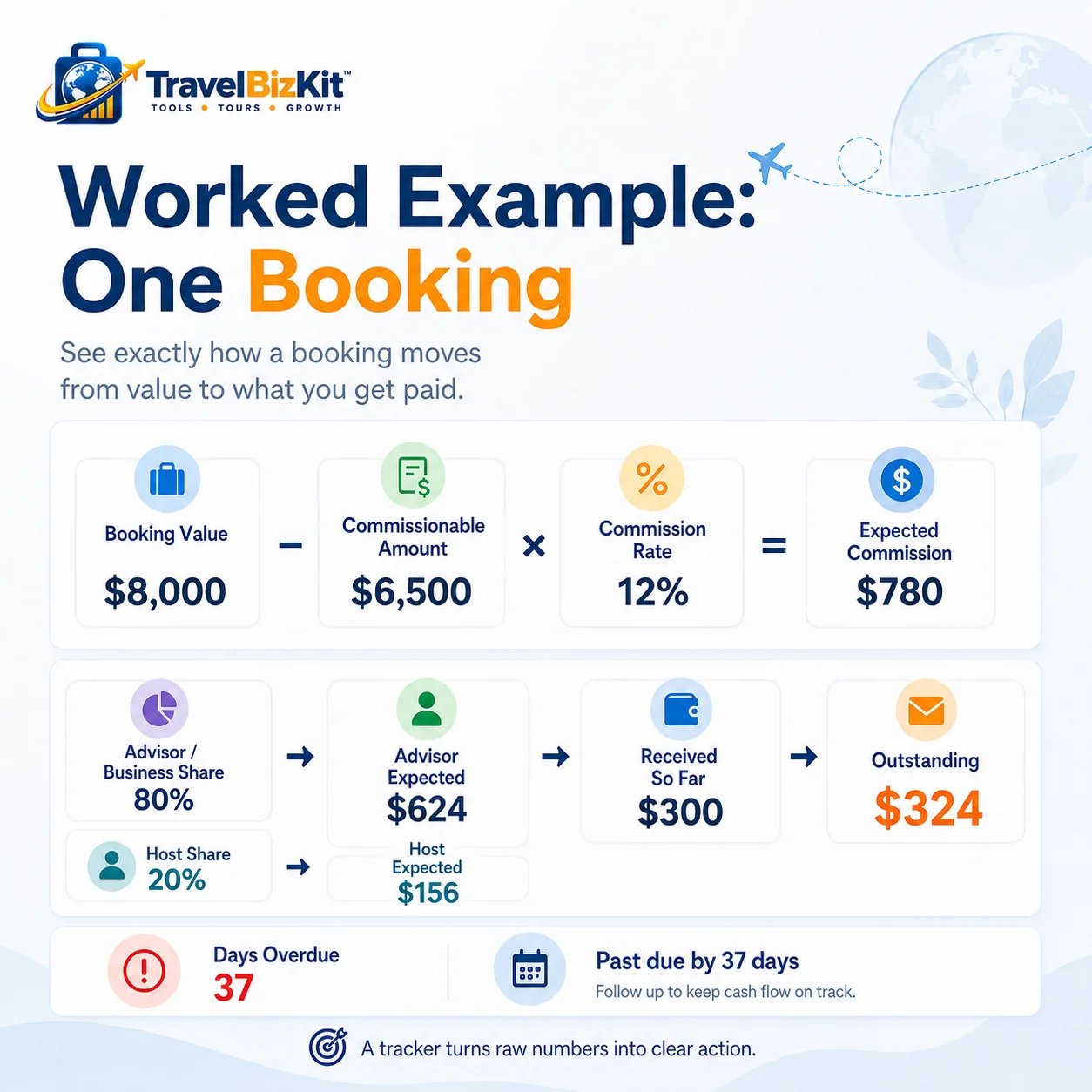
Consider this illustrative booking:
- Booking value: $8,000
- Commissionable amount: $6,500
- Supplier commission rate: 12%
Expected gross commission:
$6,500 × 12% = $780
Now assume your business keeps 80% of the supplier commission after a host split.
Expected business commission:
$780 × 80% = $624
The remaining 20% — $156 — is retained by the host under this example.
Now imagine only $300 of your expected $624 has been received so far.
Your tracker should show:
| Metric | Amount |
|---|---|
| Booking value | $8,000 |
| Commissionable amount | $6,500 |
| Expected gross commission | $780 |
| Expected business share | $624 |
| Received so far | $300 |
| Outstanding | $324 |
If the expected payment date has already passed by 37 days:
- Status: Partial / Overdue
- Outstanding amount: $324
- Days overdue: 37
That is far more useful than a spreadsheet row that simply says:
Commission: $624
The raw calculation tells you what the booking should earn.
The tracking workflow tells you what to do next.
Want to check your own numbers?
Use the Travel Agent Commission Calculator on our Free Tools page to estimate supplier commission and your share before building a more complete tracking workflow.
How to Handle Partial Commission Payments
Partial payments deserve their own workflow.
They can occur for many legitimate reasons. The important thing is not to automatically assume that the first payment closes the booking.
Imagine:
- Expected commission = $900
- First payment = $500
- Second payment expected = $400
After the first payment, the commission record should remain open:
- Received: $500
- Outstanding: $400
- Status: Partial
When the second $400 arrives:
- Received: $900
- Outstanding: $0
- Status: Received
This also means your system should allow multiple receipt records against one commission line.
Replacing the first payment amount every time money arrives destroys useful history.
Logging payments individually preserves it.
How to Track Overdue Travel Agent Commissions
An overdue commission view should answer one question quickly:
Which expected payments need attention now?
A useful recovery view should prioritize the outstanding amount together with the age of the commission.
For example:
| Booking | Outstanding | Days Overdue | Priority |
|---|---|---|---|
| Booking A | $1,200 | 42 | High |
| Booking B | $85 | 5 | Low |
| Booking C | $720 | 73 | High |
| Booking D | $300 | 1 | Review |
The exact priority rules are up to your business.
But simply sorting by booking date is usually less useful than identifying the combination of money at risk + overdue age + status.
That is the difference between a commission list and a commission recovery queue.
Commission Reconciliation: Match Payments Back to Bookings
Tracking outstanding commission becomes much more reliable when you reconcile supplier statements instead of looking only at your bank balance.
For the complete supplier-statement workflow, read our guide to travel agent commission reconciliation.
A bank deposit may tell you:
Supplier payment received: $2,340
It does not necessarily tell you which bookings created that $2,340.
A supplier statement may contain several line items tied to different bookings.
The reconciliation process is therefore:
Statement payment → Booking → Expected commission → Actual commission → Variance
Modern travel agency back-office systems explicitly use supplier-statement matching as part of commission reconciliation, including identifying matched, partially paid and unclaimed items.
Suppose a supplier statement contains:
- Booking A — $480
- Booking B — $620
- Booking C — $375
- Booking D — $865
Total:
$2,340
You should match each line to your internal booking records rather than simply recording one $2,340 commission receipt.
That makes it possible to detect:
- missing bookings,
- underpayments,
- unexpected payments,
- duplicate payments,
- supplier variances,
- and commission that belongs to another advisor or booking.
This is where travel commission reconciliation becomes much more valuable than a simple “paid / unpaid” column.
Travel Agent Commission Spreadsheet vs Commission Software
There is no single correct system for every travel business.
A solo advisor with a small number of monthly bookings may not need a full back-office SaaS platform.
A larger agency managing hundreds or thousands of revenue lines probably should not depend on a basic manual spreadsheet.
Think of the options as three levels.
A Basic Spreadsheet
A basic travel agent commission spreadsheet can work when booking volume is small and the logic is simple.
At minimum, it should track expected amount, actual amount, due date and status.
Its weakness usually appears when you introduce partial payments, multiple suppliers, host splits, advisor payouts, refunds, clawbacks and statement reconciliation.
A Structured Commission System
A structured Excel-based system sits between a simple tracker and full SaaS software.
It can make sense for an independent advisor or small agency that has outgrown a basic spreadsheet but does not need — or want — another monthly platform yet.
The key is that the workbook must contain more than formatted cells. It needs consistent calculation logic, payment records, reconciliation controls and exception reporting. You can also browse our Business Tools for practical systems built around travel-business workflows.
Full Commission Software / SaaS
Dedicated commission software becomes increasingly valuable when you need multi-user collaboration, CRM integration, automated statement ingestion, large booking volumes, sophisticated permissions, integrations or fully automated workflows.
The best choice is therefore not “spreadsheet or software?”
The better question is:
How much complexity does your current commission workflow actually need?
Common Commission Tracking Mistakes
The most damaging errors are usually not complicated accounting problems. They are process gaps.
One common mistake is calculating commission on the full booking total even when taxes, fees or other components are not commissionable.
Another is marking a commission fully paid because some money arrived.
A third is overwriting the original expected amount after a refund or correction, which makes it difficult to understand what changed.
Agencies also lose visibility when they record one large supplier deposit without matching the statement back to individual bookings.
And perhaps the simplest mistake is having no review process for old outstanding commissions.
A tracker that nobody reviews is only a database.
A useful commission system should continuously surface the exceptions that require action.
A Practical Weekly and Monthly Commission Routine
You do not need to spend every day reviewing the entire commission ledger.
A better workflow is to separate operational maintenance from reconciliation.
During the week, enter new commissionable bookings and log payments as they arrive. Keep supplier, booking and expected payment information accurate.
Then schedule a regular reconciliation review.
That review should focus on:
What became overdue? What was partially paid? What supplier statements arrived? What does not match? What needs to be chased?
At month end, compare expected commission, received commission, outstanding commission and supplier performance.
That gives your commission data value beyond recovery.
It becomes useful for cash-flow planning, advisor payouts and understanding the real profitability of your booking activity.
When a Basic Commission Spreadsheet Is No Longer Enough
You probably need a more structured system when you repeatedly find yourself doing manual checks that should already be visible.
Examples include needing to search old emails to remember whether a supplier paid, manually calculating remaining balances after partial payments, struggling to determine which advisor should receive what, or spending too much time matching supplier statements line by line.
Another sign is when the same booking appears differently in several files.
- One workbook says $800 expected.
- Another says $500 received.
- Your accounting record has a supplier deposit.
- An advisor believes they are due a payout.
- Nobody can immediately explain the difference.
That is the point where commission tracking becomes a reconciliation problem, not a calculation problem.
Once you can identify the gap, use our guide to unpaid travel agent commissions to prioritize follow-up and recover missing supplier payments.
From Commission Tracking to Commission Recovery
Knowing what is unpaid is useful.
Knowing what deserves attention first is better.
That is why we built the TravelBizKit Commission Recovery System around a broader workflow than a simple commission spreadsheet.
It tracks expected and received commission, partial and overdue items, host and advisor splits, supplier statement matching, recovery priorities, supplier performance, adjustments, payouts and data-quality controls.
The goal is straightforward:
Make the money that still needs attention difficult to overlook.
The current system also includes a dedicated QA layer for financial logic, including 60 tested scenarios covering splits, partial receipts, corrections, cancellations, clawbacks and payout rules.
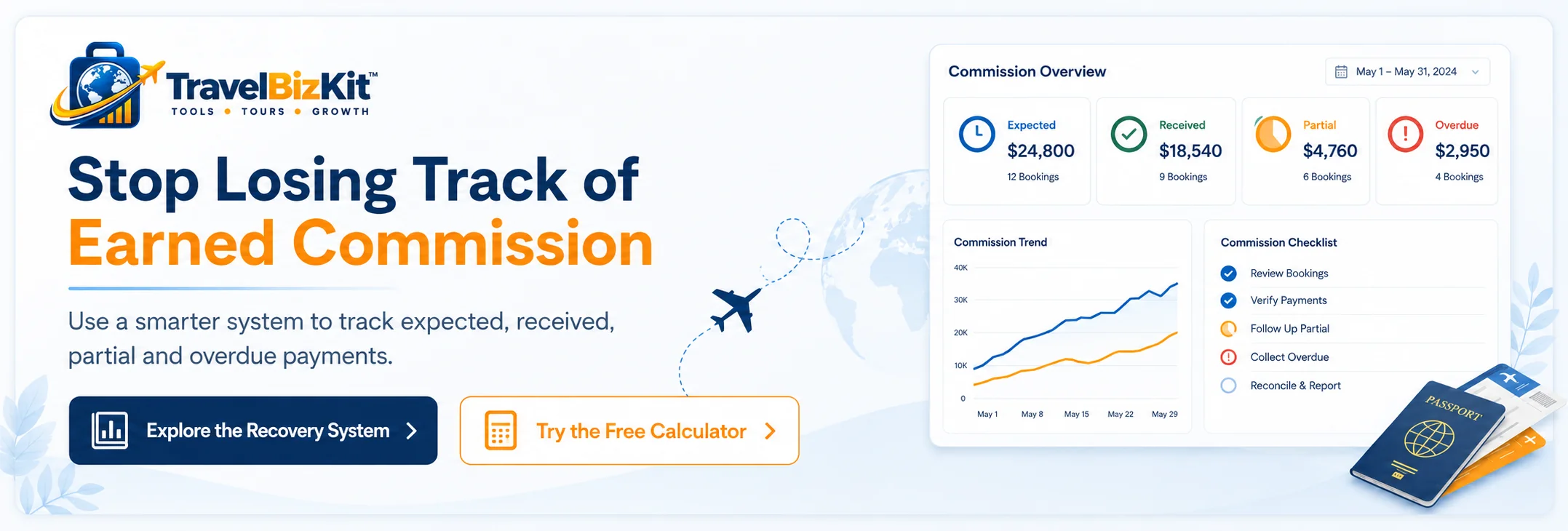
Stop Losing Track of Earned Commission
If a basic spreadsheet no longer gives you enough visibility, explore the TravelBizKit Commission Recovery System.
Frequently Asked Questions
What is the best way to track travel agent commissions?
The best system separates expected commission from actual commission received and tracks the payment status of every commissionable booking. At minimum, record the supplier, booking reference, commissionable amount, rate, expected commission, expected payment date, received amount and outstanding balance.
What should a travel agent commission tracker include?
A good travel agent commission tracker should include expected commission, received commission, partial payments, overdue items, supplier information, booking references, payment dates and outstanding amounts. Agencies with more complex workflows may also need host splits, advisor payouts, refunds, clawbacks and supplier statement reconciliation.
How do I track unpaid travel agent commissions?
Keep an expected payment date for each commission. If that date passes before the full expected amount is received, flag the remaining balance as overdue. Review overdue commissions regularly and maintain a record of follow-up actions.
How do I track partial commission payments?
Record every payment separately instead of replacing the original expected commission. Subtract cumulative payments received from the expected amount. The commission remains Partial while an outstanding balance is still expected.
What is travel agent commission reconciliation?
Commission reconciliation is the process of matching supplier commission payments or statement line items back to the bookings that generated them and comparing the actual amount received with the amount expected.
Should I use Excel or commission software?
Excel can work well for an independent advisor or small agency when the workflow is structured and booking volume is manageable. Larger teams, high transaction volumes or businesses requiring extensive integrations may benefit from dedicated commission software.
Can I track host agency commission splits?
Yes. Keep the supplier gross commission separate from the portion retained by the host and the portion ultimately due to the advisor or agency. This prevents gross commission from being mistaken for business revenue.
How often should travel agencies reconcile commissions?
There is no universal schedule. The right frequency depends on booking volume and supplier payment cycles. However, outstanding and overdue commission should be reviewed regularly enough that missing payments are identified while the booking and supplier documentation are still easy to retrieve.