
A supplier sending your agency a commission payment does not automatically mean your commission records are correct.
The money may have arrived.
But which booking earned it? Was the amount correct? Was the booking paid in full or only partially? Does part of the supplier statement belong to another advisor? Is there money on the statement that nobody in the agency can identify?
Those questions are the reason travel agent commission reconciliation matters.
Commission tracking tells you what you expect to earn. Commission reconciliation goes one step further: it proves which supplier payments belong to which bookings and identifies the gaps that still need attention.
For independent advisors and small travel agencies, this can be the difference between having a spreadsheet full of expected commission and actually knowing that the money was received correctly.
Modern travel-agency back-office systems treat this as a distinct workflow: supplier statements are recorded, statement line items are matched to bookings, unmatched amounts are tracked separately, and reconciled commissions can then progress toward advisor payout.
Key Takeaways
- Reconcile commission at booking or revenue-line level, not only by total bank deposit.
- A supplier statement total being correct does not prove every booking was paid correctly.
- Use confirmation numbers or unique booking IDs as your strongest matching key whenever possible.
- Keep Partial, Underpaid, Overpaid and Unmatched items visible until explained.
- Never force an uncertain payment into a booking just to make the statement balance.
- Record unclaimed commission separately so it can be investigated later.
- Reconciliation should happen before you consider a supplier payment fully resolved or release advisor payouts under your normal policy.
- Automation can help suggest matches, but ambiguous matches still need review.
What Is Travel Agent Commission Reconciliation?
Travel agent commission reconciliation is the process of comparing the commission payments you actually receive from suppliers or host agencies with the bookings that were expected to generate those payments.
The goal is to answer:
Does every dollar on this supplier statement have a valid booking behind it, and does every booking show the correct amount received?
Suppose your agency expected commissions from five bookings:
| Booking | Expected Commission |
|---|---|
| A | $480 |
| B | $650 |
| C | $375 |
| D | $900 |
| E | $240 |
| Total | $2,645 |
A supplier later sends a payment of $2,340. Knowing that $2,340 arrived is not enough.
You need to determine which bookings are included in that payment. Maybe Booking E is not due yet. Maybe Booking B was underpaid. Maybe Booking D does not appear on the statement. Or perhaps the supplier statement contains a commission your agency cannot immediately identify.
Until you match the payment back to individual bookings, the payment is received but not fully reconciled.
Commission Tracking vs Commission Reconciliation
These terms are related but they are not identical.
Commission Tracking
Commission tracking answers:
- What bookings are commissionable?
- How much commission do we expect?
- When should we receive it?
- What amount have we received?
- What remains outstanding?
If you haven’t already built this foundation, start with our guide to how to track travel agent commissions.
Commission Reconciliation
Reconciliation answers:
- Which supplier payment belongs to which booking?
- Does the statement amount equal the expected commission?
- Was the commission fully or partially paid?
- Is there a variance?
- Is there a statement line we cannot identify?
- Should this booking now be considered resolved?
- Is the commission ready to move into the next payout stage?
The distinction matters. A booking can show Expected Commission: $620 and your bank account may show Supplier Deposit: $3,840 without telling you whether the $620 was included in that deposit.
Reconciliation creates the link.
Why Bank Deposits Alone Are Not Enough
Imagine a host agency sends one ACH deposit for $6,450.
That deposit may represent commission from 14 hotel bookings, 3 cruise bookings, 2 insurance policies, one adjustment, and a prior-period correction.
If your accounting record only says Commission Income — $6,450, you know how much cash arrived. You do not yet know which expected commissions have been satisfied.
This is especially important when an advisor asks: “Was my commission from booking X included in this payment?”
Without booking-level reconciliation, answering that question may mean going back through statements, emails, reservation confirmations and spreadsheets manually. A reconciled system should be able to answer immediately.
What Information Should Be Used to Match Supplier Payments?
The strongest reconciliation process starts with reliable identifiers.
One of the most valuable fields is a confirmation number or unique booking reference. Requiring confirmation numbers for agency bookings makes reconciliation easier, especially when the identifier is unique.
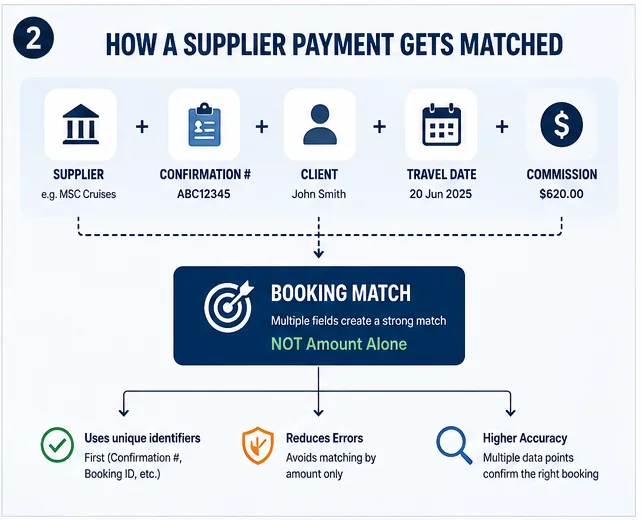
A good statement-to-booking matching hierarchy looks like this:
1. Exact Internal Revenue-Line ID
If your own system generates a unique revenue-line or transaction ID and the supplier statement contains it, this is usually the strongest possible match.
Example: REV-000845 matches exactly to REV-000845.
2. Exact Supplier Confirmation Number
Next best: Supplier + Confirmation Number. For example: MSC Cruises + ABC12345.
This is significantly more reliable than matching by amount alone.
3. Booking ID + Supplier
If your agency maintains a unique booking ID, combine that with supplier identity.
4. Composite Match
When no single perfect identifier exists, compare multiple fields together:
- Supplier
- Client name
- Travel date
- Confirmation number
- Commission amount
- Advisor
- Booking reference
The more independent fields agree, the stronger the match becomes.
5. Amount + Date
Use these only as supporting evidence. Matching a $400 statement line to a booking simply because the booking expected $400 is risky. Your agency may have several $400 commissions.
6. Manual Review
If the evidence is not strong enough, do not guess. Move the statement line into a review or unclaimed queue. That is better than creating a false match.
The 5 Results Every Statement Line Should End With
Matched
The statement payment can be confidently connected to the correct booking.
Example: Expected $480, Received $480, Variance $0. Result: Matched.
Partial / Underpaid
The booking is identifiable, but the amount received is lower than the amount still expected.
Example: Expected $650, Received $620, Variance -$30. If you still expect the $30, the result is Partial / Review.
A partially paid status should be preserved when another supplier payment is expected rather than prematurely treating the booking as complete.
Overpaid
The supplier payment exceeds the expected amount.
Example: Expected $375, Received $400, Variance +$25.
Do not automatically treat the extra $25 as profit. It may represent a bonus, an adjustment, another booking, a currency issue, or a supplier mistake.
Unmatched / Unclaimed
The statement contains money but you cannot identify the corresponding booking.
Keep it separate. Do not attach it to the closest-looking booking merely to balance the statement. Unidentified money should remain visible until an advisor or administrator identifies the underlying booking.
Duplicate / Suspicious
The same booking appears to have already been reconciled against another payment. This deserves review before anything is posted. A duplicate statement import should never silently create duplicate commission income.
A Practical Commission Reconciliation Workflow
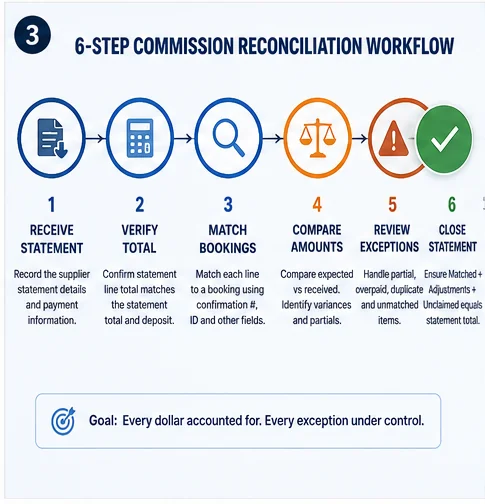
A reliable workflow can be broken into six steps.
Step 1: Record the Supplier Statement
When a supplier or host payment statement arrives, create one statement record containing:
- Supplier / host
- Statement reference
- Statement date
- Payment date
- Currency
- Total statement amount
- Payment method
- Notes
Do not begin by changing booking statuses. First preserve the source document.
Step 2: Confirm the Statement Total
Before matching individual lines, calculate the sum of statement lines and compare it with the statement header total and, where appropriate, the actual cash deposit.
Ideally, the statement line total equals the statement total and the expected cash movement can be explained.
If the statement says $4,800 but its line items total $4,675, something is already wrong before you start booking-level matching. That discrepancy should be investigated separately.
Step 3: Match Each Line to a Booking
Work through every supplier statement line. Try the strongest matching rules first:
Unique ID → Confirmation Number → Booking/Supplier combination → Composite match → Manual review
Do not jump directly to fuzzy matching. This makes your reconciliation process easier to audit later.
Step 4: Compare Expected vs Actual Commission
Once the booking is identified:
Expected Commission − Received Commission = Variance
- If Expected = Received: Matched.
- If Received < Expected: Partial / Shortfall.
- If Received > Expected: Overpayment / Adjustment Review.
The booking status should reflect the reality of the payment, not merely the fact that some money arrived.
Step 5: Separate Unclaimed Amounts
If the supplier has paid something you cannot identify, create an unclaimed record containing whatever information is available.
- Supplier
- Amount
- Client name
- Confirmation number
- Travel dates
- Advisor if known
- Statement reference
This preserves the money inside the reconciliation process while your team investigates it.
Step 6: Close the Statement Only When It Is Accounted For
A supplier statement should not be considered reconciled merely because the total payment reached your bank.
You should be able to explain:
Matched payments + approved adjustments + unclaimed amounts = statement amount
Only then is the statement fully accounted for.
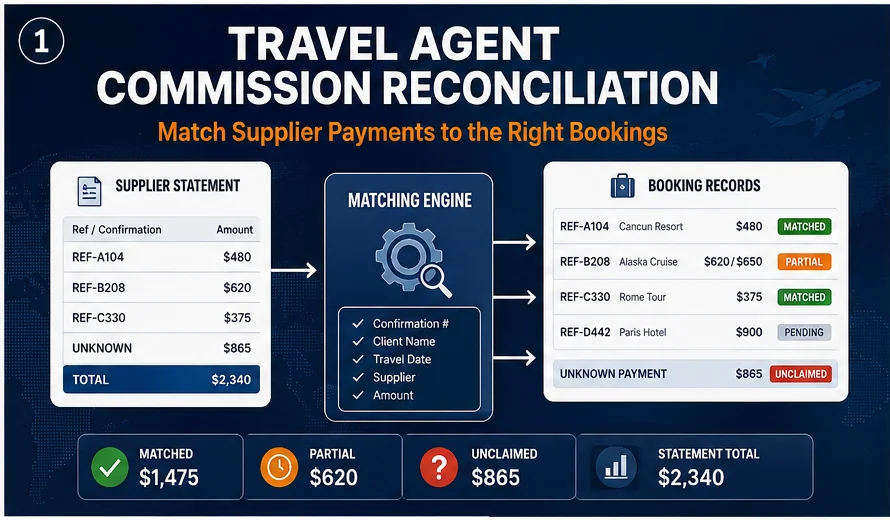
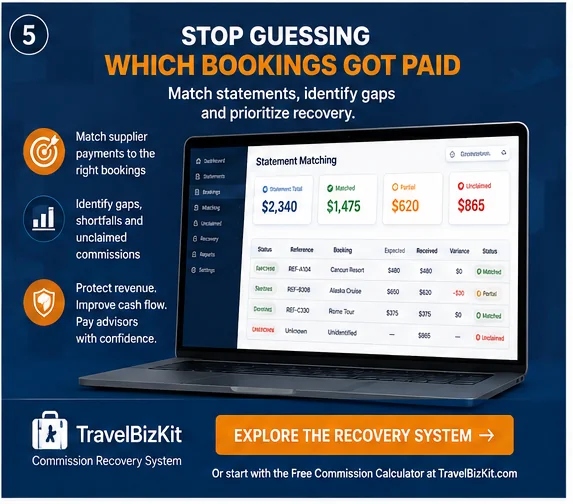
Worked Example: Reconciling a $2,340 Supplier Statement
Suppose your agency receives the following supplier statement:
Statement Total: $2,340
| Statement Line | Amount |
|---|---|
| REF-A104 | $480 |
| REF-B208 | $620 |
| REF-C330 | $375 |
| Unknown Reference | $865 |
| Total | $2,340 |
Your internal records show:
| Booking | Expected |
|---|---|
| REF-A104 | $480 |
| REF-B208 | $650 |
| REF-C330 | $375 |
| REF-D442 | $900 |
Statement Line 1
Supplier statement: REF-A104 — $480. Internal record: REF-A104 — Expected $480.
Result: Exact Match. Variance: $0. Status: Reconciled.
Statement Line 2
Supplier statement: REF-B208 — $620. Internal record: REF-B208 — Expected $650.
Result: Booking matched, amount does not. Variance: -$30. Status: Partial / Needs Review.
The booking should not disappear from your recovery view if the additional $30 is still expected.
Statement Line 3
Supplier statement: REF-C330 — $375. Internal record: REF-C330 — Expected $375.
Result: Exact Match. Status: Reconciled.
Statement Line 4
Supplier statement: Unknown — $865. You cannot confidently connect it to a booking.
Booking D expected $900, but an $865 amount by itself is not enough evidence to force a match.
Result: Unclaimed — $865.
Investigate client name, confirmation number, dates, supplier data, advisor, and statement notes.
Eventually you may discover that it does belong to Booking D. If confirmed: Expected $900, Received $865, Variance -$35. Then Booking D moves from Unclaimed to Matched / Partial — $35 still outstanding.
This illustrates an important principle:
A balanced statement is not the same thing as a correctly reconciled statement.
You could force the $865 into Booking D immediately and make your report look clean. But you would be replacing evidence with an assumption.
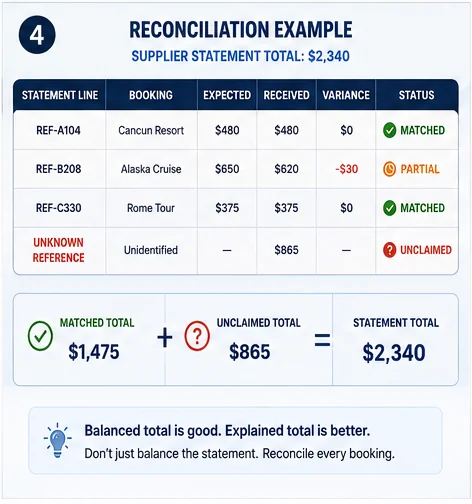
Three Totals You Should Always Keep Separate
A commission reconciliation system should ideally give you three levels of totals.
Statement Total
What the supplier says it paid. Example: $2,340.
Matched Total
How much has been linked confidently to valid bookings. For example: $480 + $620 + $375 = $1,475.
Unclaimed Total
Money still present in the statement but not tied confidently to a booking: $865.
Then: Matched $1,475 + Unclaimed $865 = Statement $2,340.
The statement is accounted for at the financial level. But the reconciliation process still has unfinished work because $865 remains unidentified.
That’s much more informative than a simple “balanced” checkbox.
How to Handle Multiple Payments for the Same Booking
One booking does not always equal one payment.
Suppose Booking X has expected commission of $1,000. Supplier Statement 1 pays $600. Later Supplier Statement 2 pays $400.
Your records should preserve both receipts:
| Payment | Amount |
|---|---|
| Statement 1 | $600 |
| Statement 2 | $400 |
| Total Received | $1,000 |
After payment one: Status = Partial. After payment two: Status = Received / Reconciled.
Do not overwrite $600 with $1,000. Store both receipts. The history matters.
Do Not Confuse Supplier Reconciliation With Advisor Payout
This is another important separation.
Supplier pays your agency. Your agency reconciles the payment. Then, depending on your business model, an advisor may become eligible for their share.
Those are different events. A supplier statement arriving does not necessarily mean the advisor should immediately be paid.
A useful system can distinguish:
- Commission expected
- Supplier payment received
- Statement reconciled
- Advisor amount calculated
- Advisor eligible for payout
- Advisor actually paid
That separation reduces another common problem: paying an advisor based on commission that was not actually reconciled correctly.
Common Reconciliation Mistakes
Matching Only by Amount
A statement row of $550 does not prove which booking generated it. Amounts repeat. Use identifiers first.
Marking a Statement Reconciled Because the Total Matches
You could have a statement total of $4,000, matched bookings of $3,200 and an unknown amount of $800. The statement adds correctly to $4,000, but there is still $800 of unexplained money.
The math is balanced. The bookings are not fully reconciled.
Losing Partial Payments
If you receive $450 against a $700 expected commission and mark the booking Received, you have hidden $250. Partial must remain a live status while additional payment is expected.
Editing Expected Commission to Match What the Supplier Paid
Expected: $500. Supplier pays: $470.
A dangerous shortcut is changing expected commission to $470 so the variance becomes zero. That destroys the evidence that a $30 difference existed. Keep expected and actual separate. Investigate the variance.
Deleting Unmatched Statement Lines
If you cannot identify a payment, do not remove it just to clean up the statement. Keep an unclaimed queue. Someone may recognize the booking later.
Paying Advisors Before Finishing Reconciliation
An advisor split should be based on a properly reconciled supplier payment under your agency policy. Otherwise you risk calculating payouts from incorrect or incomplete amounts.
Manual vs Automated Commission Reconciliation
You do not necessarily need automation on day one. For a solo advisor with a small number of transactions, a disciplined structured workbook may be enough.
As volume increases, automation can reduce repetitive matching. Modern systems such as Sion’s commission reconciliation workflow perform multiple-field and weighted matching, while Tern’s reconciliation guidance explains how statements, matches and exceptions move through the back-office process. The best workflows still preserve a review layer rather than assuming every suggested match is automatically correct.
Automate the easy matches. Review the uncertain ones. Do not automate uncertainty.
When Should You Move Beyond Manual Reconciliation?
A structured Excel workflow may still be appropriate when:
- Your agency is small.
- Booking volume is manageable.
- You have a limited number of people reconciling.
- Supplier statement formats are relatively predictable.
- You do not need live multi-user integrations.
You may be ready for dedicated SaaS when:
- Hundreds or thousands of statement lines need matching.
- Multiple administrators reconcile simultaneously.
- You need CRM/GDS integrations.
- Statements need automated ingestion.
- You require sophisticated advisor portals.
- Manual review has become a significant operational cost.
This is not about spreadsheets being “bad.” It is about using the level of system that matches your current complexity. Explore TravelBizKit Business Tools when you need practical systems built for travel workflows.
A Simple Monthly Reconciliation Checklist
Statement Control
- Statement reference recorded
- Supplier recorded
- Statement date recorded
- Payment date recorded
- Currency confirmed
- Statement total confirmed
- Statement-line total confirmed
Booking Matching
- Every exact match confirmed
- Partial payments identified
- Overpayments investigated
- Duplicate payments checked
- Unmatched lines moved to unclaimed review
Variance Control
- Expected vs actual reviewed
- Shortfalls documented
- Adjustments explained
- Refunds/clawbacks recorded separately
Payout Control
- Advisor split confirmed
- Reconciled amount confirmed
- Eligibility date confirmed
- Payout status kept separate from supplier receipt
Statement Close
Before closing: Matched + Adjustments + Unclaimed = Statement Total. No unresolved difference should be silently ignored.
What a Good Reconciliation Dashboard Should Tell You
A manager should not need to open every booking to understand the state of commission collection.
At minimum, a useful dashboard should show:
- Expected commission
- Commission cash received
- Outstanding commission
- Partial items
- Overdue items
- Unmatched receipts
- Unclaimed commission
- High-value recovery items
- Advisor payout liability
- Supplier collection performance
This changes the question from “Did we get paid?” to “What money still requires action?” That’s the more useful management question.
From Supplier Statements to a Recovery Workflow
Commission reconciliation should not end with a green checkmark.
A variance creates an action. A partial payment creates an action. An overdue booking creates an action. An unmatched statement line creates an action. An unreliable supplier pattern creates an action.
That’s why TravelBizKit’s Commission Recovery System connects statement matching to the wider commission workflow rather than treating reconciliation as an isolated spreadsheet task.
It includes:
- Expected vs received commission
- Multiple receipt records
- Partial and overdue tracking
- Statement Import & Matching
- Unmatched receipt controls
- Recovery Queue
- Supplier Performance
- Host and advisor splits
- Adjustments and clawbacks
- Data Quality checks
- Formula Integrity checks
- Management dashboard
- 60-scenario QA Lab
The goal isn’t just to make a statement balance. It’s to make unresolved commission difficult to overlook.
Reconcile Supplier Payments Without Losing the Exceptions
If your current spreadsheet tells you that a payment arrived but not which booking it belongs to, what’s still missing, and what needs to be chased, you may have outgrown basic commission tracking.
The TravelBizKit Commission Recovery System is designed for independent advisors and small agencies that need a more structured workflow without immediately moving their business into another monthly SaaS platform.
Frequently Asked Questions
What is travel agent commission reconciliation?
Travel agent commission reconciliation is the process of matching commission payments received from suppliers or host agencies to the bookings that generated those commissions, then comparing expected amounts with actual amounts received.
How do you match supplier commission payments to bookings?
Start with strong identifiers such as an internal revenue-line ID or supplier confirmation number. If an exact identifier is unavailable, compare multiple fields such as supplier, client, travel dates, advisor and commission amount. Ambiguous matches should be reviewed rather than forced.
What is an unclaimed commission?
An unclaimed commission is money shown on a supplier or host statement that cannot yet be confidently connected to an internal booking or advisor. It should remain visible until the underlying booking is identified or the payment is otherwise explained.
What happens if a supplier pays only part of the expected commission?
Record the actual amount received but keep the remaining amount outstanding if additional payment is still expected. The booking should remain Partial rather than being marked fully Received.
Should I reconcile the total payment or every booking?
Both controls are useful. Confirm the statement total, but also reconcile statement lines to individual bookings. A correct total alone does not prove that each booking was paid correctly.
Should advisor commission be paid before supplier reconciliation?
A safer operational process is to reconcile the underlying supplier payment first and then apply the agency’s payout rules. Supplier receipt, reconciliation and advisor payout should be treated as separate events.
Can AI automatically reconcile travel commissions?
Some modern travel-agency platforms can parse supplier statements and suggest or automatically identify matches. However, uncertain matches, variances and unmatched records still need appropriate review.
Is Excel enough for travel agency commission reconciliation?
It can be for a solo advisor or small agency if the workbook is properly structured and booking volume is manageable. Agencies with larger volumes, multiple administrators or extensive integrations may eventually need dedicated back-office software.
After reconciliation reveals a genuine gap, follow our guide to unpaid travel agent commissions to prioritize recovery and follow up on missing supplier payments.