

Travel advisors do more than make reservations.
A client may see the final hotel, cruise, flight or itinerary. What they don’t always see is the consultation, research, supplier comparison, itinerary design, booking administration, revisions and support behind it.
That’s one reason travel agent service fees have become an increasingly important part of the advisor business model.
But simply deciding to “charge a fee” creates a new set of questions:
What should the fee cover?
Should you charge before planning or only when the client books?
Should every client pay the same fee?
Should you charge a flat fee, consultation fee, transaction fee or package price?
And how much should you actually charge?
There isn’t one universal answer.
The right fee structure depends on the type of work you’re doing, how much time it requires, the commission economics of the booking and the service level you’re promising.
This guide will help you build a more practical approach.
Key Takeaways
-
Travel agent service fees are now common, but advisors use several different fee models.
-
A service fee, consultation fee and planning fee do not always mean exactly the same thing.
-
Charge based on the work and economics involved, not simply because another advisor charges a certain amount.
-
Consultation fees can compensate early-stage expertise and advice.
-
Planning fees can compensate research, itinerary design and customization.
-
Transaction or booking fees can make sense for specific booking activities, especially lower-commission services.
-
Change fees can protect the business when work expands after booking.
-
Your retained supplier commission should be considered when determining whether additional fee revenue is necessary.
-
Define fees and scope before doing substantial work.
-
A consistent policy is usually easier to explain and manage than making pricing decisions from scratch for every client.
Are Travel Agent Service Fees Common?
Yes.
TravelAge West’s 2025 compensation survey of 186 U.S. advisors found that 58% charged service fees sometimes or always. The same survey found that 59% of respondents who believed advisors were underpaid specifically felt advisor time was not compensated fairly. Source.
The trend continues into 2026. A Travelsavers/NEST outlook found advisors using several fee structures: transaction fees, consultation fees, service-specific fees, multiple fee types and plan-to-go fees. Taken together, 56% of respondents reported using at least one of those approaches. Source.
Host Agency Reviews’ latest published hosted-advisor data similarly says roughly 63% of advisors report charging professional fees, with 32% using both service and consultation fees. Source.
So the question is increasingly less:
“Are advisors allowed to charge fees?”
and more:
“What fee model makes sense for my business and clients?”
What Exactly Is a Travel Agent Service Fee?
The terminology varies across agencies.
That’s important because advisors sometimes use “service fee,” “planning fee” and “consultation fee” interchangeably.
Host Agency Reviews traditionally distinguishes them this way:
Service Fee
A fee connected to performing a transaction or specific booking service.
Examples might include:
-
airline ticketing,
-
rail,
-
hotel-only bookings,
-
cruise booking,
-
changes,
-
refunds,
-
cancellations,
-
individual FIT components.
Consultation Fee
A charge for the advisor’s time and expertise spent researching, planning, booking or supporting the client’s travel.
In practice, your agency may use different names.
That’s fine.
What’s more important is that the client understands:
what they’re paying for, when they’re paying it, and what is included.
For a broader profitability framework, see our guide to travel advisor planning fees.
The Main Types of Travel Advisor Fees
A modern advisor business might use one fee type or several.
Consultation Fee
This can compensate for professional advice before substantial planning begins.
It may make sense when a prospect wants:
-
destination guidance,
-
trip strategy,
-
expert recommendations,
-
consultation without committing to full-service planning.
For example:
60-minute destination consultation — $X
The point isn’t the exact number.
The point is that professional advice has a defined scope and value.
Planning / Research & Design Fee
This compensates the advisor for actually building the trip.
It may include:
-
destination research,
-
supplier comparison,
-
hotel research,
-
itinerary design,
-
proposal creation,
-
custom recommendations,
-
revisions,
-
logistical planning.
A 2026 industry guide from Travel Advisor Resource Center describes research and design fees as an important way to compensate advisors for precisely this type of work. Source.
Booking or Transaction Fee
This is connected to a specific transaction.
For example:
-
airline ticket issuance,
-
hotel-only booking,
-
rail ticket,
-
exchange,
-
cancellation,
-
refund handling.
This model can be especially useful where the booking itself produces weak or zero commission.
Change Fee
A client books.
Then the work changes.
They may request:
-
date changes,
-
hotel changes,
-
rebooking,
-
ticket changes,
-
destination changes,
-
major itinerary revisions.
If these requests create meaningful additional work, a defined change fee can stop post-booking activity from becoming unlimited unpaid service.
Package-Based Fee
Instead of charging one transaction at a time, you can bundle services.
For example:
Essential
Premium
Concierge
Each level has a defined scope.
This can make client conversations easier because they compare levels of service rather than asking only:
“Why are you charging me a fee?”
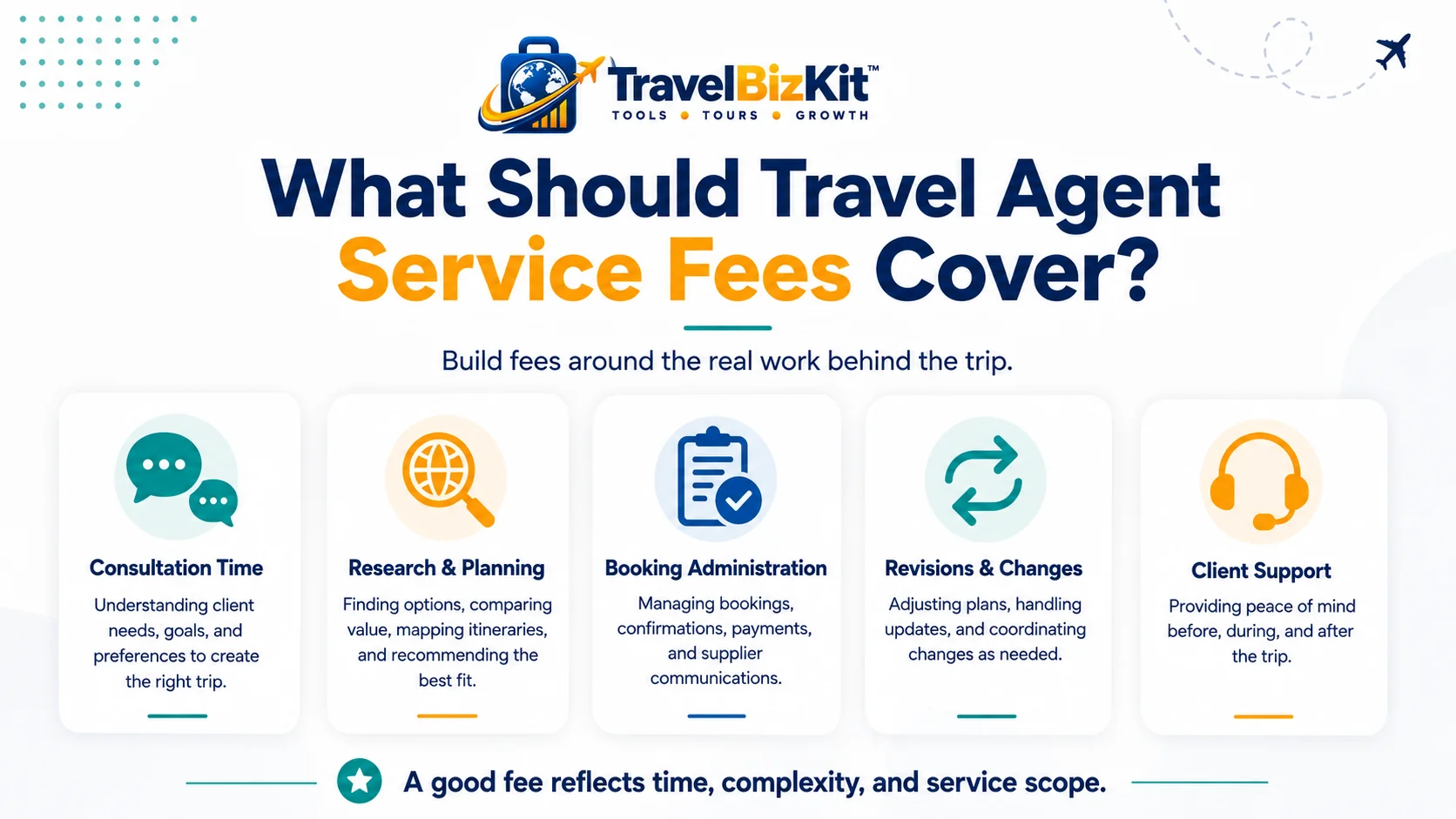
What Should Travel Agent Service Fees Cover?
A professional fee should reflect the real work performed by the business.
Depending on the service, this might include:
Consultation Time
Understanding:
-
budget,
-
interests,
-
traveler profiles,
-
priorities,
-
restrictions,
-
goals.
Even the initial conversation requires professional judgment.
Research and Planning
The client may never see:
-
the options you rejected,
-
supplier comparisons,
-
location research,
-
route analysis,
-
hotel screening,
-
internal emails.
But that work still consumes business capacity.
Booking Administration
Making the booking can involve:
-
supplier portals,
-
confirmations,
-
payment coordination,
-
documentation,
-
booking verification,
-
internal records.
Revisions and Changes
One revision may take 15 minutes.
Seven rounds of revisions can turn a profitable engagement into an unprofitable one.
This is why scope boundaries matter.
Client Support
Your role may continue after booking through:
-
questions,
-
documentation,
-
reminders,
-
supplier coordination,
-
disruptions,
-
changes.
Your service fee structure should reflect the level of support your package promises.
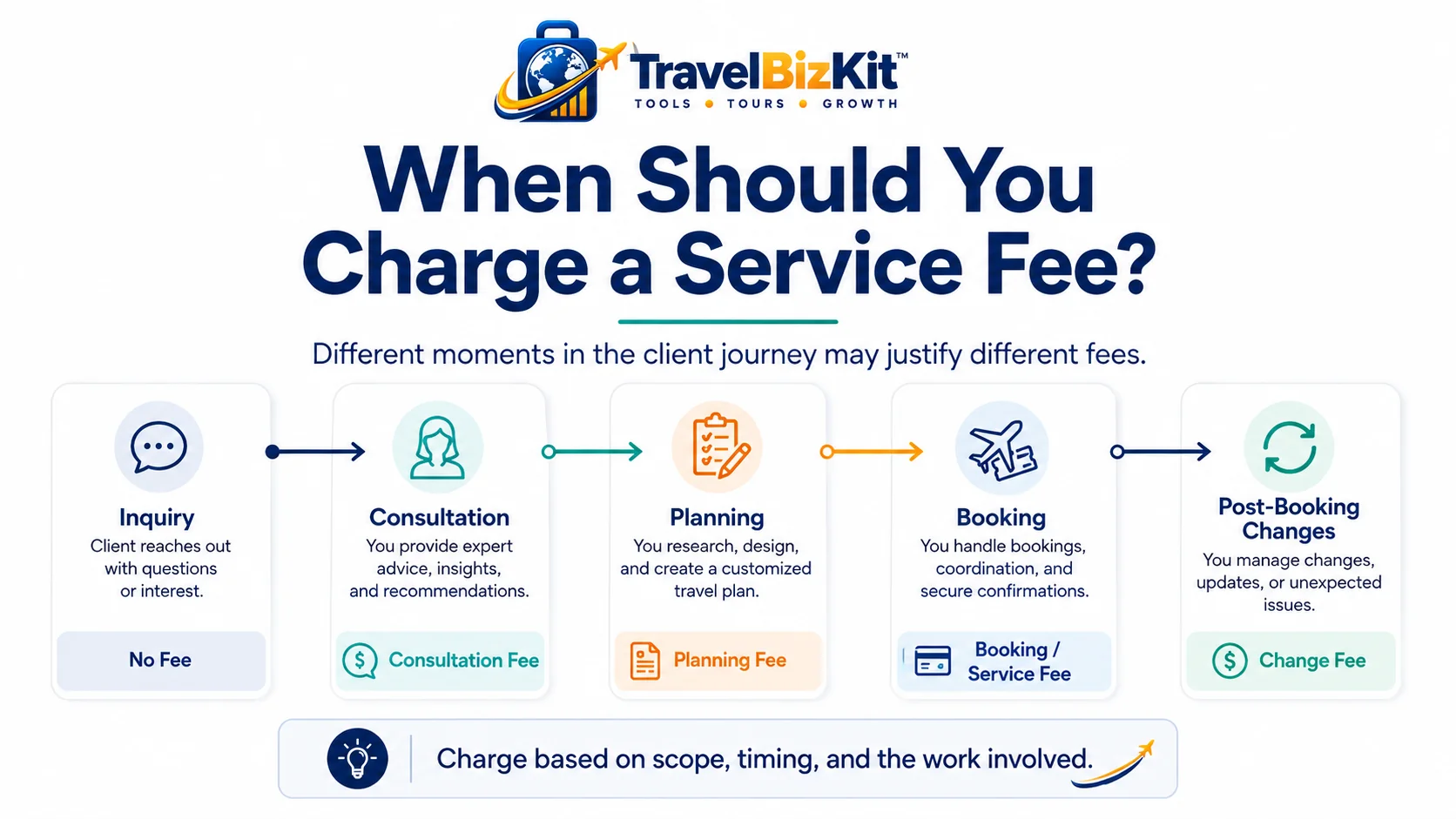
When Should You Charge a Service Fee?
Fees can apply at several points in the client journey.
At the Consultation Stage
A consultation fee can work when a client wants expert advice before engaging you for planning or booking.
This can also help distinguish serious prospects from people seeking free research.
A clear policy could say:
Professional consultation is required before customized planning begins.
Whether that consultation is separate from or included in a later fee depends on your business model.
Before Customized Planning Begins
This is usually the strongest moment for a planning fee.
Why?
Because the client is hiring you to perform work.
If you wait until after completing 10 hours of research to mention the fee, you’ve lost most of the commercial protection the fee was supposed to provide.
The client should understand the fee before substantive planning work begins.
At the Booking Transaction
Certain services may justify a transaction fee.
For example:
-
air ticketing,
-
hotel-only booking,
-
rail,
-
booking changes.
This is especially relevant where commission is limited.
When Scope Changes
Suppose the client originally asked for:
Rome + Florence
Then after planning begins:
“Can we add Paris, London and Barcelona?”
That’s a new scope.
Your policy can specify when additional work triggers:
-
additional planning fee,
-
change order,
-
hourly charge,
-
upgraded package.
After Booking Changes
Major changes after the reservation has been completed can consume substantial time.
Examples:
-
rebooking,
-
cancellation,
-
supplier changes,
-
dates moved,
-
ticket exchanges.
A predefined fee is easier to explain than inventing a number after the problem occurs.
When Might You Choose Not to Charge a Fee?
Charging fees should not become an automatic rule that ignores economics or relationships.
There may be situations where a no-fee model works.
For example:
-
highly profitable low-effort booking,
-
strategic repeat client,
-
commission is strong enough to support the work,
-
promotional campaign,
-
specific relationship policy.
The important thing is to understand what you’re giving up.
If you waive a $300 planning fee, that is economically different when:
Scenario A
Commission contribution = $1,500
Time cost = $250
versus:
Scenario B
Commission contribution = $250
Time cost = $600
The same fee waiver has completely different consequences.
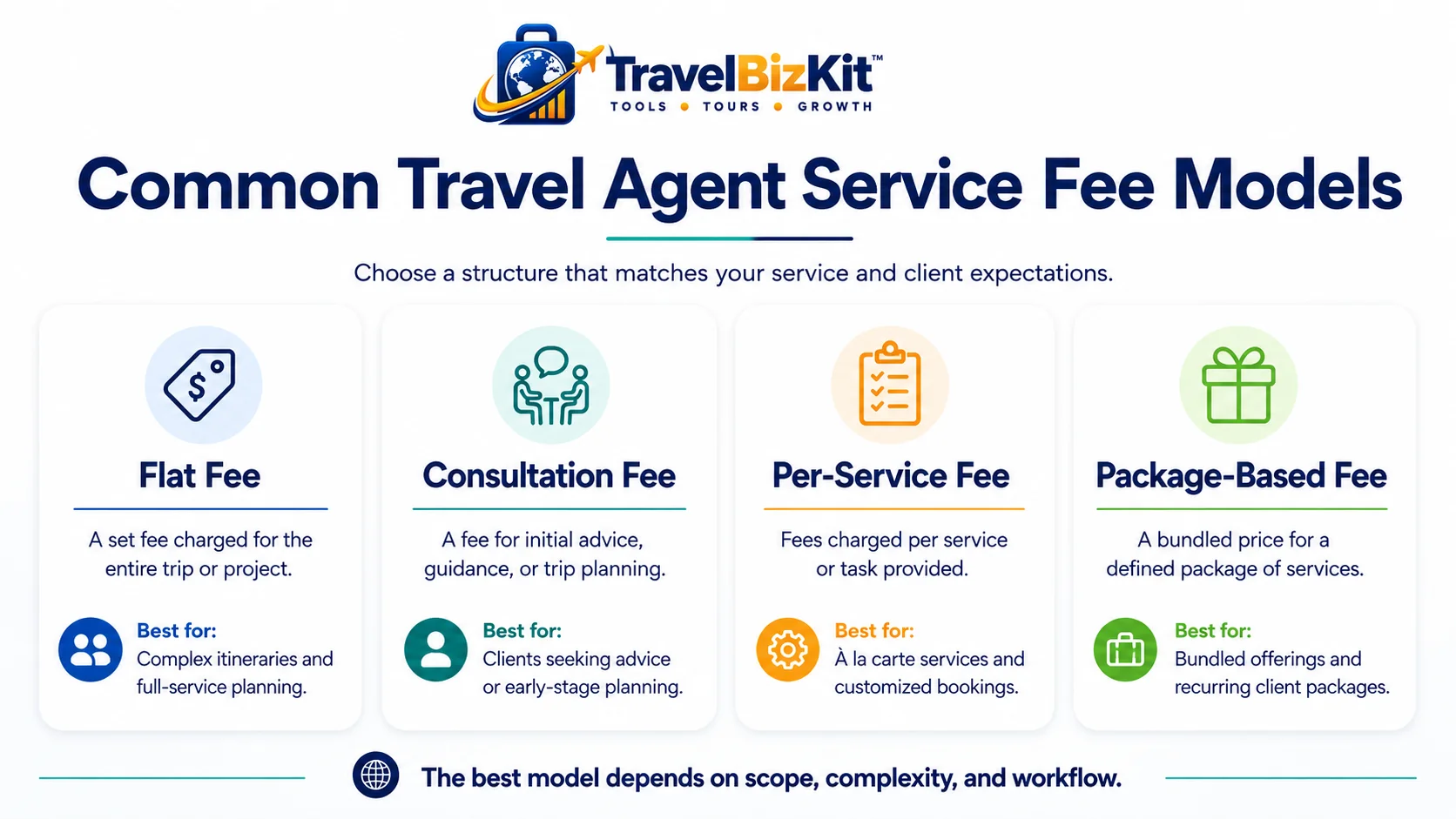
Common Travel Agent Service Fee Models
There are several practical structures.
Flat Fee
Example:
Full trip planning — $300
Pros
-
Simple.
-
Easy to communicate.
-
Predictable.
Best when
The scope is reasonably predictable.
Risk
The client can expand the work while the price stays fixed.
Consultation Fee
Example:
60-minute travel strategy consultation — $150
Best when
The client needs professional advice but may not yet be ready for full planning.
Per-Service Fee
Example:
-
air ticketing — $X
-
change — $Y
-
complex FIT planning — $Z
Best when
Different transactions have clearly different workloads.
Package-Based Pricing
Example:
Basic
Premium
Concierge
Each package can define:
-
services,
-
revisions,
-
support,
-
scope,
-
response expectations.
This can be especially useful for leisure advisors offering highly differentiated levels of planning.
Flat Fee vs Hourly Pricing
Hourly pricing can be useful if scope is unpredictable.
For example:
$75/hour
The client pays according to actual time.
The benefit:
You are protected against extra work.
The downside:
Some clients may become overly focused on tracking hours.
Flat pricing shifts the conversation toward the outcome and service.
A hybrid approach is also possible:
Fixed fee includes up to X scope, then additional work billed under a defined policy.
How Much Should a Travel Agent Charge?
There is no industry number that applies to everyone.
TravelAge West’s 2025 survey found that the largest group of respondents reported average service fees below $200. An earlier 2022 survey found many advisor fees concentrated between roughly $50 and $300 per client. Source.
Those figures provide market context.
They are not a pricing rule.
A $150 fee might be excellent for one booking and terrible for another.
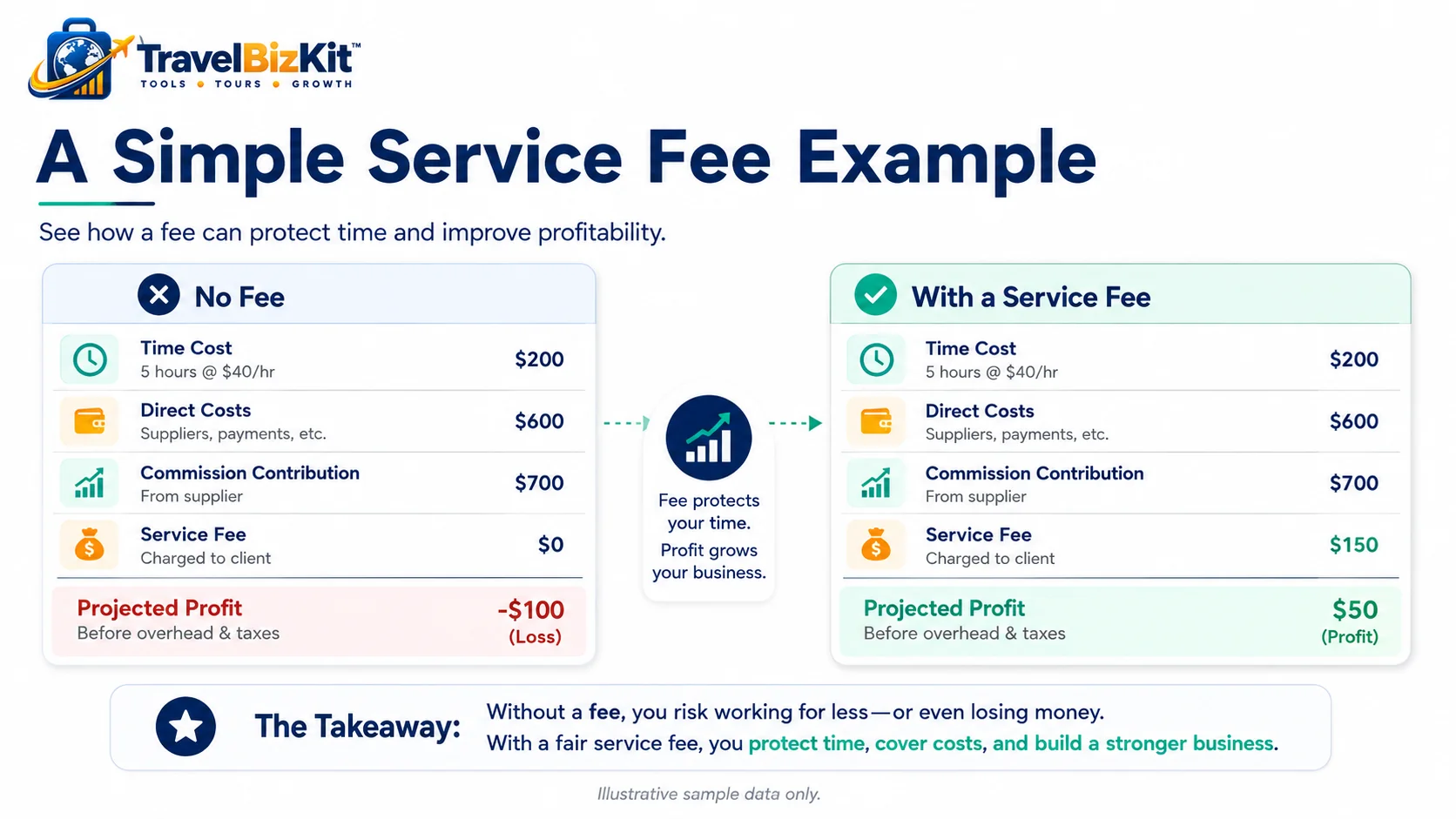
A Better Way to Calculate the Fee
Start with the economics.
Time Cost
Suppose:
5 hours × $40/hour
=
$200
Direct Costs
Assume the business has:
$600
in direct costs attributable to this illustrative engagement.
Net Commission Contribution
Assume retained commission:
$700
Without a Fee
Revenue:
$700
Costs:
$200 + $600
=
$800
Projected result:
-$100
With a $150 Service Fee
Revenue:
$700 + $150
=
$850
Costs:
$800
Projected result:
$50
A Simple Service Fee Example
This example is intentionally simplified.
It shows an important principle:
Supplier commission does not automatically make the service profitable.
The relevant question is:
Does retained commission + fee revenue cover the cost of delivering the service and produce the result you want?
Use Your Own Numbers
Don’t copy the $150.
Calculate your own scenario.
Use the:
It can estimate:
-
Time Cost
-
Net Expected Commission
-
Break-Even Fee
-
Fee to Reach Target Profit
-
Profit With No Fee
-
Profit With Your Proposed Fee
Service Fee vs Planning Fee
These can overlap, but they solve different business problems.
Service Fee
Often protects the economics of a specific transaction or service.
Planning Fee
Often compensates the broader process of researching, designing and creating the trip.
You may use:
one
or
both
depending on your model.
Example:
Planning fee:
$400
Air ticketing fee:
$50/ticket
Change fee:
$75/change
Again, these are illustrative.
Your policy needs to reflect your own work.
Service Fee vs Supplier Commission
Supplier commission and professional fees are both revenue, but they originate differently.
Supplier Commission
Paid by the supplier according to its agreement.
Client Fee
Paid by the traveler directly for professional services.
That distinction matters.
Commission may also arrive long after the planning work is completed.
TravelAge West’s 2025 survey found that 39% of respondents identified receiving commission after travel as a compensation challenge. Source.
A client fee can create revenue closer to when professional work is actually being performed.
If supplier income is part of your model, it also helps to understand how to track travel agent commissions from expected to received.
Low-Commission and Noncommissionable Bookings
Service fees can be particularly useful for services where supplier commission is low or nonexistent.
Historically, air ticketing has been one of the most common examples cited in advisor fee research. Source.
Suppose a client wants:
-
complex international flights,
-
multiple ticket changes,
-
specific fare research.
If supplier revenue is minimal but the work is substantial, the economics can become negative without a professional fee.
Should Fees Be the Same for Every Client?
Not necessarily.
The better goal is a consistent policy, not necessarily an identical dollar amount.
TravelAge West has specifically explored whether planning fees should vary between clients, new advisors, referrals and booking types, reflecting the fact that fee models are often more nuanced than “every client pays $200.” Source.
You might have rules such as:
Simple Booking
Lower fee.
Customized FIT
Higher planning fee.
Group
Custom pricing.
Concierge
Premium package.
Rush Request
Additional rush fee.
Consistency comes from applying the same rules to similar work.
Define What the Fee Includes
A fee becomes harder to defend when nobody knows what it buys.
Instead of:
Planning fee — $500
explain:
Includes initial consultation, destination research, custom itinerary design, supplier coordination and up to three revision rounds.
Now the client can evaluate the service.
Revision Limits Matter
A client may say:
“It’s just one little change.”
But twenty little changes can become hours.
Define things like:
-
revision allowance,
-
major itinerary changes,
-
destination changes,
-
post-approval changes.
You don’t have to charge for every small adjustment.
But you should know where included service ends.
Explain Fees Before Doing the Work
One of the most important operational rules:
Do not surprise the client with a professional fee after substantial work is complete.
Before starting, explain:
-
the amount,
-
what it covers,
-
when it is due,
-
whether it is refundable,
-
what happens if scope changes.
The specific contractual language should be reviewed under your own applicable legal requirements.
How to Explain a Travel Agent Service Fee
Don’t make the fee sound like an apology.
Instead of:
“Unfortunately I have to charge $250.”
Use:
“My professional planning service includes destination research, itinerary design, supplier coordination and support. The fee for this scope is $250.”
The second version explains the service being purchased.
What if the Client Pushes Back?
A client may say:
“I thought travel agents were free.”
A calm answer:
“Suppliers may compensate agencies for certain bookings, but my professional fee covers the planning and service included in this engagement.”
Then explain the actual scope.
Don’t attack advisors who don’t charge fees.
Different businesses have different models.
Will Charging Fees Lose Clients?
Potentially some.
TravelAge West’s 2022 survey found that some advisors believed they had lost business because of fees, while many considered that acceptable because those prospects were not the right fit. The same research found 64% of fee-charging respondents said clients generally had no problem paying their fees. Source.
The objective is not:
Get every prospect.
It’s:
Build a profitable client base aligned with your service model.
Start With One Clear Policy
If you’re introducing fees for the first time, you don’t need 17 different charges.
You might start with:
Planning Fee
for custom itineraries.
Air Ticketing Fee
for flight-only transactions.
Change Fee
for significant changes.
Then adjust after gathering real data.
Track Whether Your Fees Actually Work
Don’t judge a fee structure only by:
“Did the client pay?”
Track:
-
fee quoted,
-
fee collected,
-
planning hours,
-
actual commission,
-
direct costs,
-
profitability,
-
discount or waiver,
-
scope creep.
Over time you’ll learn:
This booking type needs a higher fee.
or:
This supplier commission already supports simple bookings.
or:
My change fee is too low for the actual work involved.
Build Fee Packages
Once you understand your economics, packages can make your offer easier to sell.
For example:
Essential
-
consultation
-
basic research
-
booking support
-
limited revisions
Premium
-
custom itinerary
-
supplier research
-
multiple revisions
-
enhanced support
Concierge
-
complex itinerary design
-
higher-touch coordination
-
priority support
-
expanded scope
Don’t copy these names or inclusions blindly.
Build packages around what your business actually delivers.
Charge for Scope, Not for the Client’s Wealth
A client’s budget may affect trip complexity.
But a professional fee should be explainable through the service.
Avoid:
They have money, so I’ll charge more.
Instead:
This itinerary requires more destinations, supplier coordination, research and support, so it falls into our Premium planning scope.
Much easier to defend.
Don’t Let AI Make You Underprice Your Expertise
Clients now have easy access to AI for basic research.
That doesn’t mean professional advisor work has no value.
It means advisors need to be clearer about where their professional value lies:
-
judgment,
-
supplier knowledge,
-
trip design,
-
personalization,
-
risk management,
-
coordination,
-
support,
-
accountability.
AI may help someone generate a list of hotels.
That is not the same as professionally managing a client’s travel engagement.
Your Fee Model Should Be Profitable Even When the Trip Changes
A pricing model that works only when everything goes perfectly is fragile.
Ask:
What if:
-
planning takes 20% longer?
-
commission is 15% lower?
-
the client requests another revision?
-
supplier availability changes?
More advanced pricing systems can stress-test the engagement before the quote is issued.
From Service Fees to a Complete Pricing System
A service-fee list answers:
“What do we charge for booking air?”
A professional pricing system answers:
“Is this engagement profitable?”
That’s a bigger question.
That’s why the TravelBizKit Travel Advisor Fee & Profitability System combines:
-
Fee Calculator
-
Time & Labor Cost
-
Commission & Host Split Economics
-
Complexity Scoring
-
Pricing Decision Center
-
Profit Guardrails
-
Fee Waiver Gate
-
Sensitivity Analysis
-
Scope Creep Control
-
Basic / Premium / Concierge Package Builder
-
Client Fee Quote
-
Historical Calibration
-
Annual Fee Impact
-
Trip Profitability
-
120 QA Scenarios
A calculator can reveal the gap. The Travel Advisor Fee & Profitability System helps turn that number into a repeatable pricing process.
Or start free:
Explore more practical pricing and operating resources in TravelBizKit Business Tools.
Frequently Asked Questions
What is a travel agent service fee?
A travel agent service fee is a charge paid by the client for a professional service or transaction performed by the travel agency. Depending on the agency, it may apply to booking, ticketing, changes or other defined services.
What is the difference between a service fee and a planning fee?
Service fees are often associated with specific transactions or services, while planning or consultation fees generally compensate broader professional work such as research, itinerary design and advice. Agencies may use these terms differently.
How much should a travel agent charge as a service fee?
There is no universal amount. Consider the time required, direct costs, retained supplier commission, complexity, service scope and target profit.
Do travel agents charge fees in addition to commission?
Yes. Many advisors use both client-paid professional fees and supplier commission as part of their revenue model. Source.
When should a travel agent collect a planning fee?
A planning fee is generally best disclosed and agreed before substantial custom planning begins. Your specific payment and refund policy should be clearly communicated.
Should travel agent service fees be refundable?
That depends on the fee type, business policy and applicable law. Research or planning work may already have been performed even if the client later cancels. Obtain appropriate legal guidance for your terms.
Should travel advisors charge change fees?
They may choose to when post-booking changes require substantial additional work. Define the policy before the situation arises.
Should every travel client pay the same fee?
Not necessarily. Different scopes can justify different pricing. What matters is having a consistent, explainable fee policy.
Can new travel advisors charge fees?
Yes, but new advisors should calculate their own workload and value rather than simply copying experienced specialists’ prices.
Can I waive a service fee for a repeat client?
Yes, if that fits your strategy. Calculate the economics first so you understand the value of the exception.
What is a plan-to-go fee?
It’s a model where an upfront fee is paid before planning and may later be applied toward the booking under the agency’s policy. Different agencies structure these differently. Source.
Are travel agent fees becoming more common?
Current industry surveys indicate professional fees are widely used and increasingly mainstream among advisors. Source.