
Charging a planning fee is often easier than talking about the planning fee.
You may already know your research, itinerary design, supplier coordination and client support have real value.
But when it is time to tell a prospect:
“My professional planning fee for this trip is $X.”
the conversation can suddenly feel uncomfortable.
You may worry that the client will think:
-
“Aren’t travel agents free?”
-
“Don’t suppliers already pay you?”
-
“Why should I pay before I book?”
-
“Another advisor doesn’t charge.”
-
“Can you waive the fee?”
-
“Why is it this expensive?”
That discomfort causes some advisors to do something worse than losing a prospect:
They perform substantial planning work before clearly agreeing how that work will be compensated.
A strong fee conversation should not feel defensive or apologetic.
It should help the client understand three things:
what you do, what they receive, and what the professional service costs.
Recent industry guidance is increasingly direct on this point. Travel Advisor Resource Center recommends explaining exactly what the fee covers and introducing it before substantial research begins, while TravelAge West has similarly highlighted transparency about business model and professional value when clients question advisor fees. Source.
This guide gives you a practical framework, sample scripts and objection responses you can adapt to your own travel business.
Key Takeaways
-
Lead with value and scope, not the dollar amount.
-
Explain what professional planning includes before presenting the fee.
-
State your fee clearly; don’t apologize for it.
-
Tell the client when the fee is due and what happens next.
-
Keep the same core message across calls, emails, your website and proposals.
-
Prepare responses to common objections instead of improvising under pressure.
-
Don’t attack advisors who use a different business model.
-
Don’t promise that a fee will “save the client money”; focus on the professional service and outcomes you actually provide.
-
Introduce fees before doing significant custom planning.
-
For existing clients, explain the new model as a change in your professional process — not as a punishment or surprise increase.
-
A fee conversation becomes easier when your own pricing is backed by clear economics.
This guide shows how to explain travel planning fees to clients with a clear, value-first conversation. For the pricing foundation behind that conversation, review our guides to travel advisor planning fees and travel agent service fees.
Why Travel Advisors Struggle to Explain Fees
Most advisors who feel uncomfortable discussing fees don’t necessarily have a pricing problem.
They often have a positioning problem.
If you think:
“I’m asking the client to pay me $300 for something they used to think was free.”
the fee will feel difficult to explain.
If instead you think:
“The client is engaging my professional planning service, which includes research, itinerary design, coordination and support.”
the conversation becomes more natural.
Host Agency Reviews identifies hesitation around fees as a longstanding issue among advisors, including concerns about losing clients, competition from online booking and discomfort charging loyal customers. More recent industry guidance continues to address the same questions around client pushback and confidence. Source.
The goal is not to become “better at defending your fee.”
The goal is to stop treating it like something that needs defending.
What Clients Actually Want to Understand
When a client asks:
“Why is there a planning fee?”
they may really be asking:
What am I getting?
They want to understand the service.
Why isn’t supplier commission enough?
They may not understand how advisor compensation works.
Will this make my trip easier or better?
They want to understand the practical value.
What happens after I pay?
They want certainty.
What happens if the trip changes?
They want to understand scope and support.
Is this fee fair and consistent?
They want confidence that the number wasn’t invented because of their budget.
If your communication answers those questions clearly, the fee becomes much easier to understand.
Lead With Value, Not With the Fee
One of the weakest ways to introduce a planning fee is:
“Before we start, I just need to let you know that unfortunately I charge a $300 fee.”
The word unfortunately immediately frames your own service as a negative.
You’ve told the client how to feel before they have even considered the value.
Instead, start with the service.
For example:
“For this type of trip, I provide a full planning service that includes destination research, hotel and supplier comparison, itinerary design, coordination and up to three revision rounds.”
Then:
“The professional planning fee for that scope is $300.”
Now the fee has context.
TravelAge West has repeatedly advised that advisors explain how they work, what they provide and why the professional service has value rather than becoming defensive when clients question fees. Source.
A Simple Framework for Explaining Travel Planning Fees
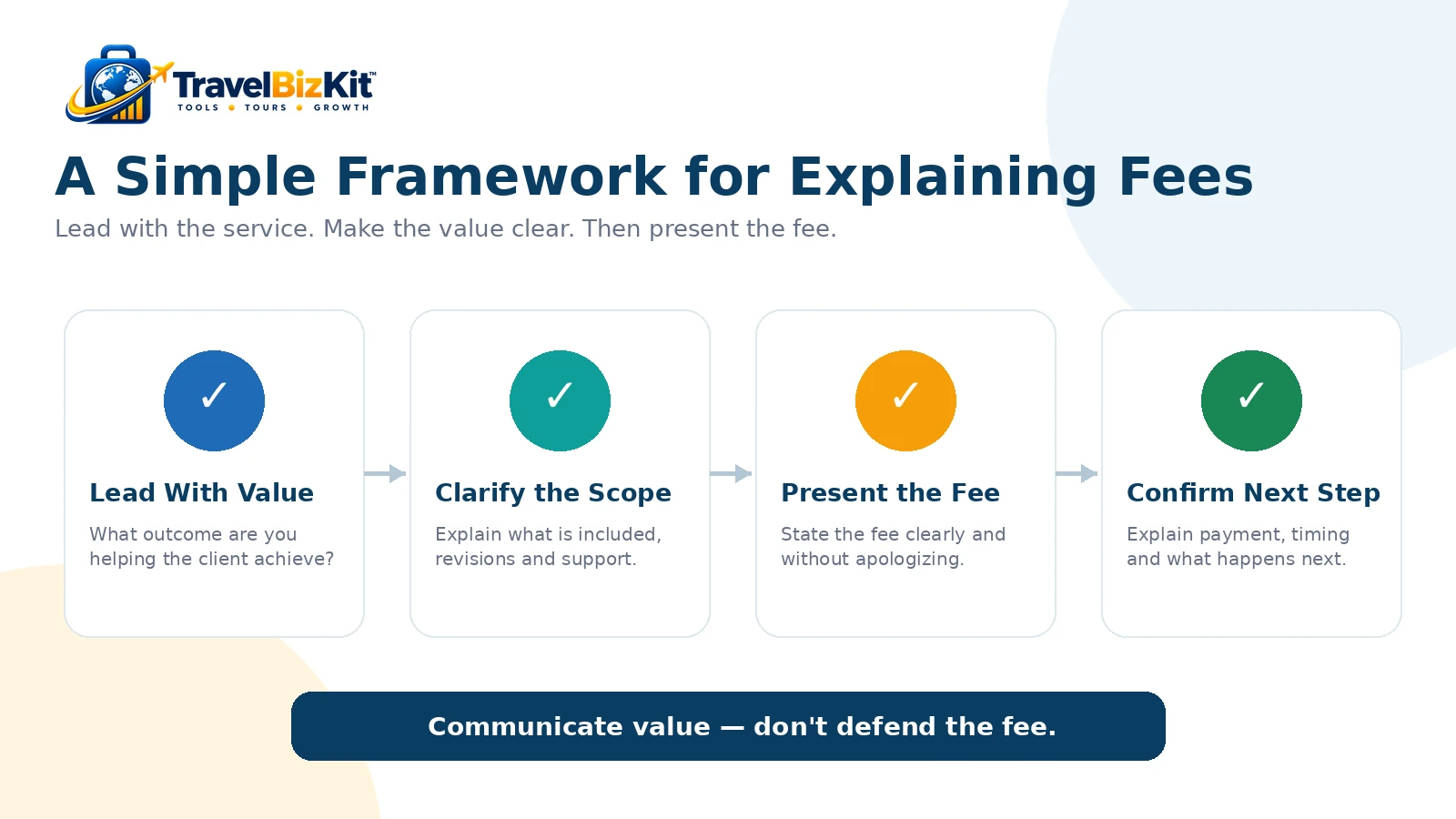
Use this four-step structure.
Step 1 — Lead With the Client’s Goal
Start with the trip.
Not your fee.
For example:
“From what you’ve shared, you’re looking for a customized Italy itinerary that balances sightseeing with slower days and includes hotels that work well for your family.”
This shows the client you understand the engagement.
Step 2 — Explain the Work You Will Perform
Now explain your process.
For example:
“I’ll research the destinations, compare hotel and transportation options, build the itinerary, coordinate suppliers and refine the plan with you before booking.”
The fee conversation now has a service attached to it.
Step 3 — Present the Fee Clearly
Then state the amount.
“The planning fee for this scope is $350.”
No apology.
No five-minute justification.
No nervous discount.
Step 4 — Confirm What Happens Next
“Once the fee is completed, I’ll begin research and you’ll receive the first proposal according to the timeline we discussed.”
This reduces ambiguity.
The full flow becomes:
Goal → Service → Fee → Next Step
That’s much stronger than:
Fee → Justification → More Justification → Discount.
Use:
travel-planning-fee-conversation-framework.webp
after the framework section.
A Simple Planning Fee Script
Here is a script you can adapt:
“Based on the trip you’re describing, my professional planning service will include destination research, customized itinerary design, supplier recommendations, booking coordination and the agreed revision rounds. The planning fee for this scope is $X. Once that’s completed, I’ll begin the research and planning process.”
That’s enough.
You can then answer questions if the client has them.
You do not need to provide an essay before they have objected.
A More Premium / High-Touch Script
“For a trip of this complexity, I work through my Premium Planning service. That includes customized research, itinerary design, supplier coordination, booking support and ongoing planning guidance. The professional fee for that service is $X. I’ll send you the complete scope and next steps in writing so everything is clear before we begin.”
Again:
service first, price second.
Consultation Fee Script
If you’re charging specifically for expert consultation:
“The consultation is a focused session where we’ll work through your destination options, priorities and trip strategy together. The consultation fee is $X for X minutes, and you’ll leave with clear recommendations and next steps.”
This makes it obvious the client is purchasing expertise, not simply access to a salesperson.
Don’t Overexplain Supplier Commission
Clients sometimes ask:
“Don’t hotels or cruise lines already pay you?”
You don’t need to give them a masterclass in supplier economics.
A simple response:
“Some suppliers may compensate my agency when a booking is completed. The planning fee is separate and covers the professional research, design and support involved in creating and managing your trip.”
That’s accurate without oversharing your margins or commission splits.
Industry advisors have used essentially this distinction for years: supplier commission relates to the travel transaction, while professional planning fees compensate the advisor’s time and expertise outside the supplier payment itself. Source.
What Not to Say
Avoid:
“I know $300 sounds like a lot.”
You just created the objection.
Avoid:
“Everyone charges this now.”
Not everyone does.
Avoid:
“I have to charge because commissions are terrible.”
That positions the fee as your financial problem.
Avoid:
“I’ll save you more than the fee.”
Unless you can genuinely guarantee that — which you usually cannot.
Avoid:
“I normally charge $400, but I can do $200 for you.”
Unless that concession follows a real policy or scope adjustment, you’ve taught the client that your published fee was negotiable from the beginning.
How to Handle Planning Fee Objections
The best objection response follows three steps:
Acknowledge → Clarify → Reconnect to Value
Not:
Defend → Argue → Discount
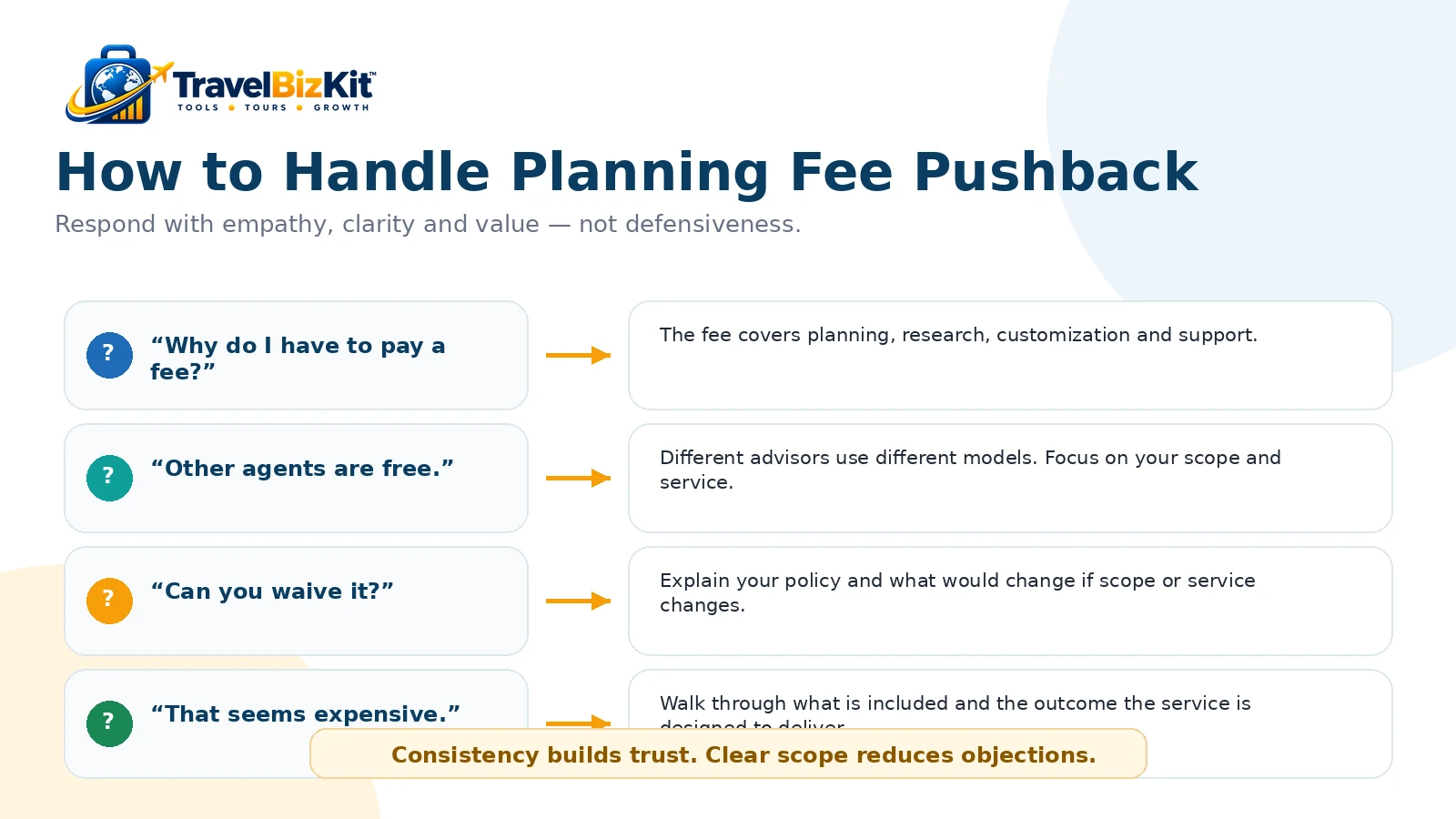
Objection: “I Thought Travel Agents Were Free”
Possible response:
“I understand why you’d think that. Some suppliers do compensate agencies for certain bookings. My planning fee covers the research, itinerary design, coordination and professional support involved in this engagement.”
Then stop.
Let the client respond.
Objection: “Another Advisor Doesn’t Charge a Fee”
Possible response:
“Absolutely — different agencies use different business models. My service includes the planning and support we’ve discussed, and the fee reflects that scope.”
Don’t say:
“They’re probably not as good as me.”
Different business models exist.
Objection: “Can You Waive the Fee?”
Possible response:
“I keep my fee policy consistent for this service level because it covers the planning work involved. If you’d like, we can look at whether a different service scope would be a better fit.”
That’s far stronger than instantly discounting.
Your full pricing system can separately help you decide when a waiver makes economic sense.
Objection: “That Seems Expensive”
Possible response:
“I understand. Let me walk you through exactly what’s included so you can decide whether the service is the right fit.”
Then show:
-
research,
-
customization,
-
coordination,
-
revisions,
-
support.
TravelAge West’s guidance on fee objections similarly emphasizes transparency and explaining what professional planning actually involves rather than becoming defensive about the price itself. Source.
Objection: “Can’t I Just Book This Online?”
Possible response:
“You absolutely can book travel independently. My service is for clients who want professional research, itinerary design, coordination and support rather than managing the entire process themselves.”
You don’t need to pretend online booking does not exist.
Your value has to survive the fact that it does.
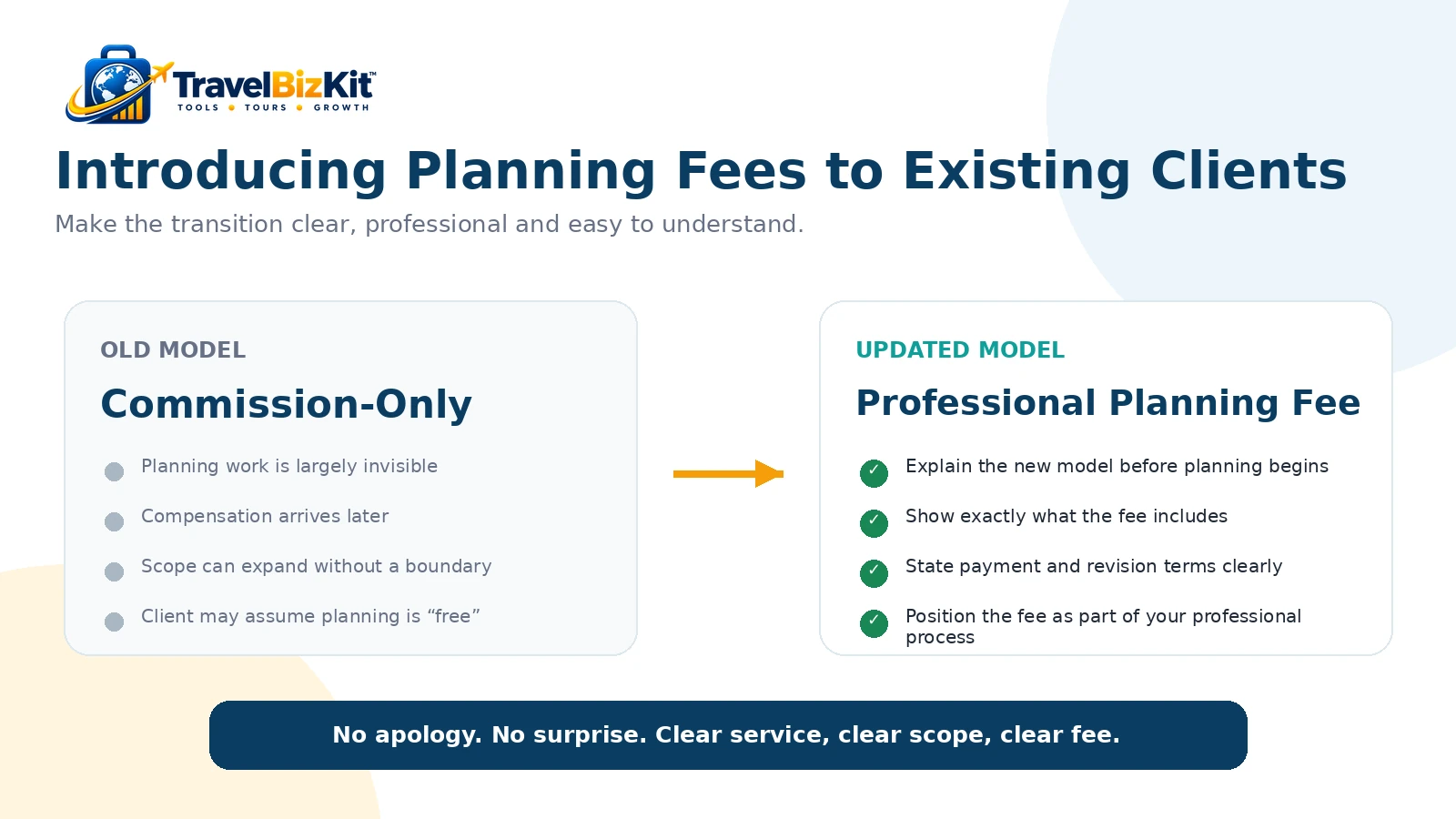
Existing Clients: “But You Never Charged Me Before”
This is a different conversation.
The client isn’t necessarily questioning your value.
They’re reacting to a change.
Use language like:
“I’ve updated my planning model so I can continue providing the level of research, customization and support my clients rely on. Going forward, customized trips will include a professional planning fee based on the scope.”
Then tell them what their specific fee is.
Travel Advisor Resource Center’s current 2026 guide recommends a similarly straightforward transition: explain the updated business model, state the fee confidently and clearly list what it covers rather than apologizing excessively. Source.
Should You Grandfather Existing Clients?
That’s a business decision.
Possible approaches include:
Everyone Moves to the New Policy
Simple and consistent.
Existing Clients Receive a Temporary Introductory Fee
For example:
“Your standard planning fee under the new model would be $400. For your next trip, I’m applying a returning-client rate of $250.”
Now the discount is visible as an exception.
Certain Client Segments Follow Different Rules
For example, you may have an internal policy around high-retained-commission repeat clients.
Whatever you choose, try to make it a policy, not an emotional decision made differently every time.
Don’t Hide the Fee Until the Call
A prospect should ideally have some understanding of your model before you are deep into custom planning.
The fee can appear in:
-
your How We Work page,
-
inquiry form,
-
consultation booking flow,
-
FAQ,
-
welcome guide.
You do not always need to display an exact universal price if your fees vary.
You can say:
“Professional planning fees apply based on trip scope and complexity.”
or:
“Custom planning services begin at $X.”
if that reflects your actual policy.
Industry examples also show advisors communicating fees upfront through “How We Work” guides and terms, which reduces surprise later in the relationship. Source.
The Website Fee Explanation
Your website copy should answer:
Why is there a fee?
Because customized planning requires professional time and expertise.
What does it include?
List the real service.
When is it paid?
Explain clearly.
Is it refundable?
Use your actual policy and legal terms.
What happens after payment?
Give the next step.
Sample Website Copy
Professional Planning Fees
Customized travel planning requires dedicated research, itinerary design, supplier coordination and ongoing professional support. Planning fees are based on the scope and complexity of your trip and are agreed before substantive planning begins.
Your proposal will clearly outline the service included, the professional fee, revision allowance and next steps.
Simple.
Professional.
No apology.
Explain Scope Before Fee Differences
Suppose you offer:
Essential — $200
Premium — $450
Concierge — $800
If the only visible difference is price, clients naturally gravitate to the cheapest one.
Instead show scope.
Example:
Now they are choosing service.
Not just price.
Don’t Create “Fake Packages”
Three packages are only useful if there are real differences.
Don’t create:
Basic / Premium / VIP
and put essentially the same service in all three.
Your packages should reflect genuine differences in:
-
time,
-
deliverables,
-
customization,
-
revisions,
-
support,
-
complexity.
Your Proposal Should Repeat the Fee Clearly
Never assume:
“We discussed the fee on Zoom, so it’s fine.”
The proposal or confirmation should restate:
-
fee,
-
deposit,
-
scope,
-
revisions,
-
cancellation/refund terms,
-
additional-work policy.
Written clarity protects both sides.
Sample Proposal Language
Professional Planning Service — $450
Includes:
destination and accommodation research,
customized itinerary design,
supplier coordination,
three revision rounds,
booking support,
pre-travel planning support.
Planning begins once the professional fee is completed according to the agreed terms.
Adapt to your actual service.
A Client Doesn’t Need to Know Your Internal Profit Formula
The client doesn’t need to see:
-
Time cost = $420
-
Target profit = $200
-
Commission dependency = 57%
-
Protected fee = $620
-
Negotiation floor = $440
Those are management numbers.
The client should see:
Premium Planning Service — $550
and what’s included.
That’s why TravelBizKit’s Fee & Profitability System separates internal economics from a client-facing quote.
Should You Explain Exactly How Many Hours You Work?
Not necessarily.
If you’re selling an hourly service, yes.
If you’re selling a fixed professional service, the value isn’t simply the number of hours.
Think of it like professional design.
Two people can spend different amounts of time and produce different levels of quality.
Your fee may reflect:
-
expertise,
-
scope,
-
risk,
-
time,
-
support,
-
complexity.
Not just the stopwatch.
Avoid the “My Time Is Worth $X” Debate With Clients
Your internal hourly value is useful for pricing.
But saying:
“My time is worth $100/hour.”
can turn the client conversation into:
“Why?”
Instead:
“The professional planning service for this scope is $500.”
Much cleaner.
Use your hourly economics internally.
Sell the service externally.
How to Introduce the Fee in Email
Example:
Subject: Next Steps for Your Custom Travel Planning
Hi [Name],
It was great learning more about the trip you’re planning.
Based on the scope we discussed, your planning service will include [short list].
The professional planning fee for this engagement is $X.
Once the fee is completed, I’ll begin the research and design phase and we’ll move into [next step].
I’ve included the service details and terms below so everything is clear before we begin.
Best,
[Advisor Name]
Short.
Clear.
No five-paragraph defense.
How to Explain Fees on a Consultation Call
A natural sequence:
First
Learn about the trip.
Second
Explain your process.
Third
Confirm the service fits.
Fourth
State the fee.
For example:
“Based on what you’re looking for, this would fall under my Premium Planning service. That includes [scope]. The professional planning fee is $450.”
Then pause.
Don’t immediately start negotiating against yourself.
Silence Is Not an Objection
This matters.
You say:
“The planning fee is $450.”
The client pauses for three seconds.
Many advisors panic and say:
“But I can probably discount that…”
Don’t.
They may simply be processing the information.
Let them respond.
How to Use the Fee to Qualify Clients
A professional fee is not only revenue.
It can also help distinguish:
-
serious clients,
-
information gatherers,
-
prospects shopping many advisors,
-
people who actually value professional support.
Recent TravelAge West commentary has gone as far as recommending a “no planning fee, no itinerary work” boundary to protect advisors from spending major design hours on uncommitted inquiries. Source.
You don’t need to adopt that exact rule.
But you do need to decide:
At what point does free conversation become professional work?
Build a Clear Free-to-Paid Boundary
For example:
Free
-
inquiry form,
-
15-minute fit call,
-
high-level conversation.
Paid
-
customized research,
-
hotel comparison,
-
itinerary creation,
-
supplier sourcing,
-
detailed recommendation.
This makes the boundary understandable.
Handling a Referral Who Expected “Free”
Scenario:
A great client refers a friend.
The friend says:
“Sarah told me you help her with trips, but she never mentioned a fee.”
Response:
“I’m glad Sarah connected us. My current planning model includes a professional fee for customized trips. For the type of trip you’re considering, the fee is $X and includes [scope].”
You don’t need to explain Sarah’s private pricing arrangement.
Should You Discount Fees for Repeat Clients?
Possibly.
But create a rule.
Example:
Standard fee:
$500
Returning client rate:
$400
Now it’s a business policy.
Not:
“They looked uncomfortable, so I panicked and cut $100.”
Track Your Discounts and Waivers
Every discount should be visible internally.
If during a year you quote:
$20,000 in fees
but collect:
$14,000
you have:
$6,000 fee leakage
That doesn’t automatically mean the discounts were bad.
It means you should know they happened.
TravelBizKit’s Fee & Profitability System tracks discount and waiver leakage specifically for this reason.
If Clients Constantly Reject the Fee, Investigate the Whole Offer
Do not immediately conclude:
“My fee is too high.”
The problem could be:
Wrong clients
They’re highly price-sensitive.
Poor positioning
They don’t understand the service.
Weak scope
The package doesn’t sound valuable.
Bad timing
You reveal the fee after they expected free work.
Actual price mismatch
Yes, the price may genuinely be wrong for your audience.
Use data.
Don’t solve every sales problem by dropping the price.
How to Position Fees as a Professional Standard
The fee should feel like part of your process.
Not a random extra.
For example:
Inquiry → Consultation → Planning Service → Proposal → Booking
The fee belongs inside that process.
Consistent professional fee communication has long been emphasized in travel-industry guidance; inconsistent charging can create confusion or mistrust, while clearly defined service tiers make the model easier for clients to understand. Source.
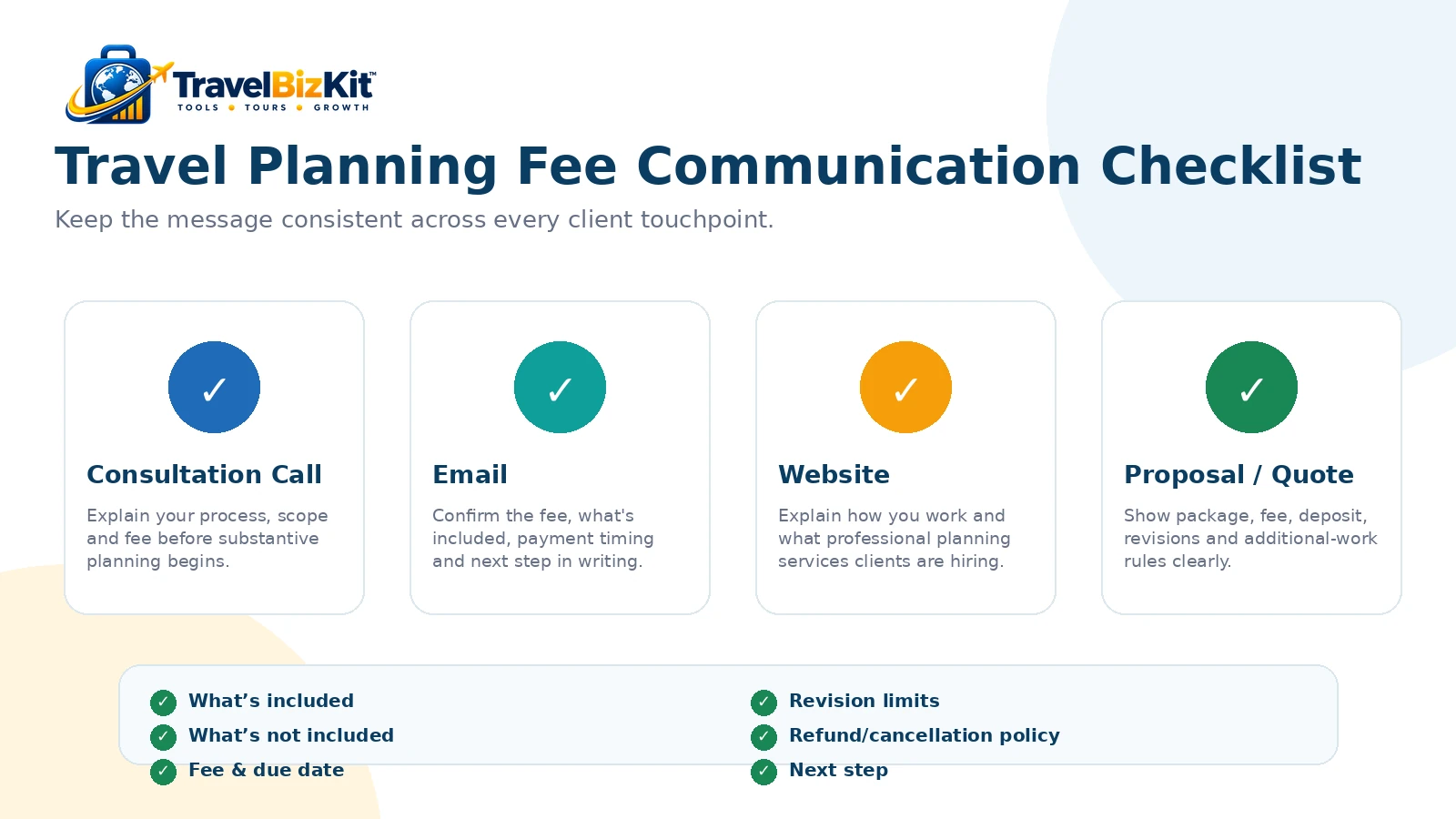
Place:
travel-planning-fee-communication-checklist.webp
here.
Your Fee Communication Checklist
Before a client begins planning, confirm they understand:
What’s included
Research? Itinerary? Support?
What’s not included
Flights? Restaurant reservations? Unlimited revisions?
Fee amount
No ambiguity.
When it’s due
Before research? Deposit + balance?
Revision policy
How many?
Additional work
What triggers another fee?
Cancellation / Refund Policy
Use your actual legal policy.
What happens next
First proposal timeline or next meeting.
Use the Same Core Message Everywhere
Your:
-
website,
-
inquiry form,
-
call,
-
email,
-
proposal,
-
payment request,
shouldn’t tell six different stories.
Consistency creates confidence.
A Fee Script Library Is Better Than Improvisation
You don’t need to read a robotic script.
But you should have prepared language for:
-
new prospects,
-
repeat clients,
-
objections,
-
fee increases,
-
package differences,
-
waived-fee exceptions,
-
scope expansion.
This prevents emotional discounting.
Example: Client Says “I’ll Think About It”
Don’t chase immediately with a discount.
Respond:
“Absolutely. I’ll send you the service scope and fee in writing so you can review everything. If you decide it’s the right fit, the next step will be [X].”
Professional.
No pressure.
Example: Client Wants Detailed Research Before Paying
“I’m happy to answer general questions during our consultation. Customized research and itinerary design begin once the planning engagement is confirmed.”
That’s your boundary.
Example: “Can You Send Me a Few Hotel Options First?”
Possible response:
“Hotel research and comparison are part of the customized planning service, so I begin that work once the planning engagement is confirmed.”
Simple.
Do Not Promise Savings to Justify Your Fee
Avoid:
“I’ll definitely save you more than the $400 fee.”
Travel pricing changes.
You cannot always guarantee that.
Instead:
“My role is to provide professional planning, recommendations, coordination and support.”
Much safer.
Don’t Build Your Fee Around Fear of Losing the Client
Your pricing needs to support your business.
TravelAge West’s 2022 fee survey found some advisors believed they had lost potential business because of fees, but 64% of respondents said their clients had no problem paying them. Source.
Not every client is your client.
A sustainable business model doesn’t require a 100% close rate.
Calculate the Fee Before You Explain It
Confidence is much easier when you understand your number.
If you don’t know:
-
your time cost,
-
expected commission,
-
target profit,
-
scope,
you may feel like you’re inventing the fee.
Use:
to estimate:
-
time cost,
-
commission contribution,
-
break-even fee,
-
target-profit fee,
-
no-fee economics.
From Confident Communication to Profitable Pricing
Good communication helps clients understand the fee.
But first, the fee itself needs to make sense.
TravelBizKit’s Travel Advisor Fee & Profitability System helps with the part clients don’t see:
-
Fee Calculator
-
Time & Labor Cost
-
Host Split Economics
-
Complexity Score
-
Pricing Decision Center
-
Profit Guardrails
-
Sensitivity Matrix
-
Fee Waiver Decision Gate
-
Scope Creep Guardrail
-
Basic / Premium / Concierge Packages
-
Client Fee Quote Builder
-
Historical Calibration
-
Annual Fee Impact
-
Trip Profitability
-
Fee Tracking
-
Scripts
-
Objection Handling
-
120 QA Scenarios
Explore more practical pricing and operating resources in TravelBizKit Business Tools.
Frequently Asked Questions
How do I explain a travel planning fee to a client?
Explain the professional service first: research, itinerary design, supplier coordination, revisions and support. Then state the fee clearly and explain what happens after payment.
Should I apologize for charging a planning fee?
No. Present it professionally as part of your service model. Over-apologizing can make the fee sound unreasonable before the client has even objected.
What if a client says travel agents are free?
Explain that some suppliers may compensate agencies for bookings, while the planning fee compensates the professional planning and support included in the engagement.
What if another travel advisor does not charge fees?
Different travel businesses use different compensation models. Focus on explaining your own service scope instead of criticizing another advisor.
Should I put planning fees on my website?
If appropriate for your business, explaining that professional planning fees apply can reduce surprises. You may display a starting fee or explain that pricing varies based on scope and complexity.
When should I tell the client about the fee?
Before substantial customized research or itinerary work begins. The client should understand the scope and fee before engaging the service.
How do I introduce planning fees to existing clients?
Explain that your professional service model has evolved and describe what the fee enables you to provide. Tell them clearly what the updated service includes and when the new fee applies.
Should I waive fees for repeat clients?
You can make strategic exceptions, but understand the economics first and ideally use a consistent internal policy.
What if a client says the fee is too expensive?
Acknowledge the concern and explain the scope. If appropriate, offer a different service level rather than automatically discounting the same scope.
How can I avoid planning work before payment?
Define a clear boundary between free qualification/consultation and paid custom planning. Explain when research and itinerary design begin.
Should the fee be refundable?
That depends on your terms, jurisdiction and the nature of the service. Use a clear written policy and appropriate legal guidance.
How do I explain fees in an email?
Briefly summarize the client’s goal, describe the planning scope, state the fee, and explain the next step. Don’t bury the fee inside a long justification.
Can I charge both planning fees and supplier commission?
Yes. Many advisors combine professional fees with supplier commission. They are separate revenue sources tied to different parts of the business model. Source.